

How to Do ChatGPT SEO in 30 Minutes
ChatGPT SEO is how you become the business ChatGPT recommends. A 30-minute walkthrough for Australian service owners, from UnderCurrent Automations.

Quick answer: ChatGPT SEO is the work of making your business the answer ChatGPT gives when someone asks for a recommendation in your field. No algorithm to game, no ad slot to buy. You get there by being easy to find, easy to trust, and described consistently everywhere it matters: your website, your Google Business Profile, your reviews, the directories you appear in, and the odd best-of list. Most of the groundwork takes about 30 minutes. Start with the basics today.
Someone two suburbs over opens ChatGPT and types "best plumber near me" or "good bookkeeper in Brunswick". A tidy list of two or three names comes back. If your business isn't on it, you didn't lose to a competitor's ad budget. You lost because ChatGPT had nothing recent and trustworthy to pull your name from.
That's the gap ChatGPT SEO closes, and most of it is plumbing, not magic. This guide is the 30-minute version: the handful of moves a service owner can make this week to start showing up. If you want the deeper, section-by-section breakdown of the citation signals AI engines look for, our guide on how to rank in ChatGPT search covers each one, and our ChatGPT Search glossary entry is the one-screen definition of the product itself. This guide stays practical, and it sits inside our AI search visibility cluster, so the links at the end go further on every step. Nothing here costs money, and you won't need a developer for most of it.
What Is ChatGPT SEO, Really?
ChatGPT SEO is the practice of getting your business named when ChatGPT recommends someone in your field, and of making the facts it states about you correct. Generative engine optimisation refers to the same job across every AI answer tool: ChatGPT, Perplexity, Gemini, Microsoft Copilot, and Google's AI Overviews. People also call it AI SEO or AEO, short for answer engine optimisation. The label moves around. The job doesn't.
ChatGPT doesn't have a ranking page you can climb. When it names a plumber in Coburg or an accountant in Newtown, it stitches together what it learned during training, what it can fetch from the live web when search is switched on, and the patterns in how the rest of the internet describes you. There's no ad slot to buy your way in either, though paid placements may be coming to ChatGPT. So the lever isn't a keyword you repeat. It's whether your business shows up, consistently and credibly, in the sources ChatGPT leans on: your own site, your Google Business Profile, review platforms, solid directories, and articles that mention you by name. If you've never thought about answer engine optimisation before, the 30-minute checklist below is where to start.
Why Should an Australian Service Business Care About ChatGPT SEO?
Because a real and growing share of "who should I hire" questions now start in a chat box, not a search bar, so businesses missing from those answers are invisible at the moment someone is ready to buy. Semrush's review of 17 months of ChatGPT clickstream data describes a clear shift in search habits toward chat for recommendation-style questions, and a running set of ChatGPT usage statistics tracks the platform well past hundreds of millions of weekly users. Australia is ahead of the pack: a roundup of ChatGPT usage in Australia puts local weekly use among the highest in the world per head.
It isn't only consumers. The Australian Bureau of Statistics AI transparency statement sets out how it manages AI in its own work, and the ABS used ChatGPT to refresh descriptions for 1,076 occupations, reportedly saving about 1,600 hours of manual work. The Treasury has written publicly about government getting good results from AI. When that's the baseline, "my customers don't use ChatGPT" stops being a safe bet, and yet most service owners are named in maybe 1 in 4 of the questions they would expect to win.
How Does ChatGPT Decide Which Business to Recommend?
It doesn't "decide" the way Google ranks pages, it reconstructs an answer from the most consistent, credible signals it can find about businesses in your category and area.
Four things do the heavy lifting
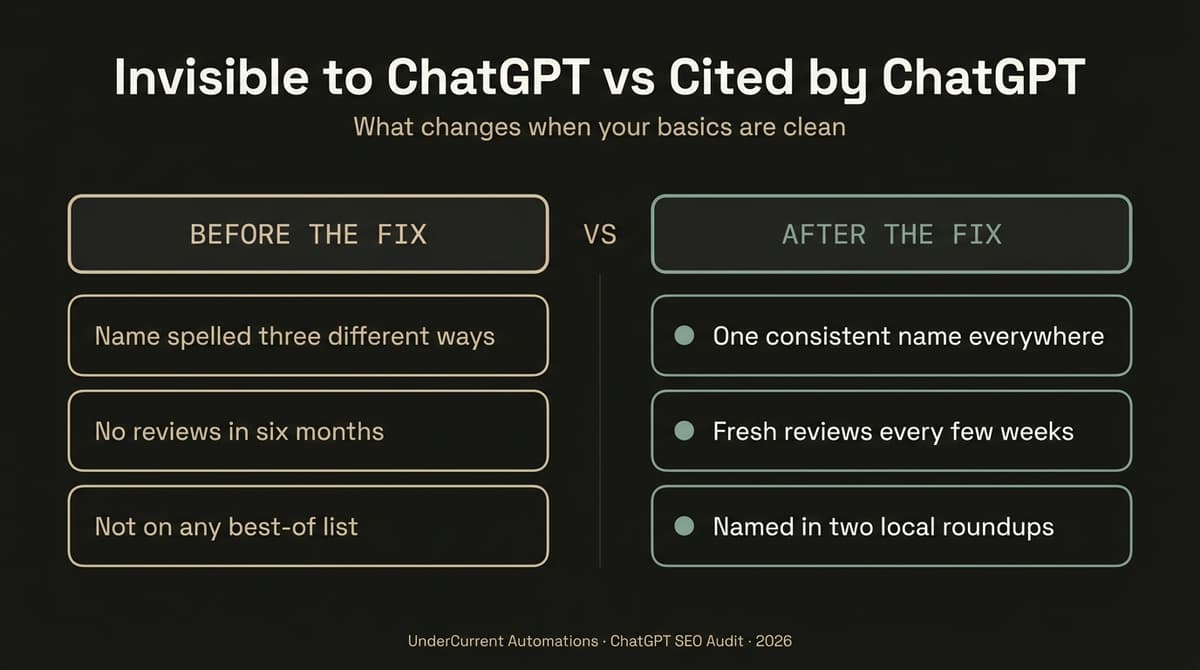
- Identity: your name, address, phone, category, and service area must match across your site, your Google Business Profile, and the directories you appear in, or you look like two half-businesses instead of one real one.
- Reputation: a trickle of recent reviews reads as "people use this business", while a last review 18 months old reads as a business gone quiet.
- Third-party mentions: being named on sites you don't control, a local roundup, a directory, a news mention, is the closest thing to a vote AI engines have.
- Structure: a site that says plainly what you do, where, and for whom is easy to quote.
None of that's exotic. It's the same trust stack behind why some tradies struggle to get Google reviews and the gaps a basic SEO self-check flags. A 2023 study even found people answered everyday search tasks faster in a chat than by scanning a results page (arXiv preprint), and local SEO benchmarks keep pointing at consistent business data as the lever.
ChatGPT SEO vs Traditional Google SEO: What Actually Changes?
Most of your old SEO instincts still help, but the win condition flips: instead of climbing to a high blue-link ranking, you want to be one of two or three names a written answer hands over. The table below sums up the difference.
| What you work on | Traditional Google SEO | ChatGPT SEO |
|---|---|---|
| The win condition | A top-10 ranking | Named in a 2-to-3 business answer |
| The main lever | Backlinks and keywords | Consistent facts, recent reviews, third-party mentions |
| Adoption signal | Mature and slowing | Weekly use among Australian adults near 28% and rising |
| Younger users | Mostly still on Google | Around 40% reach for ChatGPT first |
| Time to move | 6 to 12 months on hard terms | 3 to 4 months once the basics are clean |
| Cost to start | A paid tool or retainer | $0, plus about 30 minutes |
Keep doing real Google SEO, because ranking on Google in Australia still drives most discovery, but stop treating AI answers as someone else's job. The split is unpacked further in AI search vs traditional SEO in Australia, AI search vs traditional search in 2026, and AI SEO statistics for 2026.
How Do You Do ChatGPT SEO in 30 Minutes?
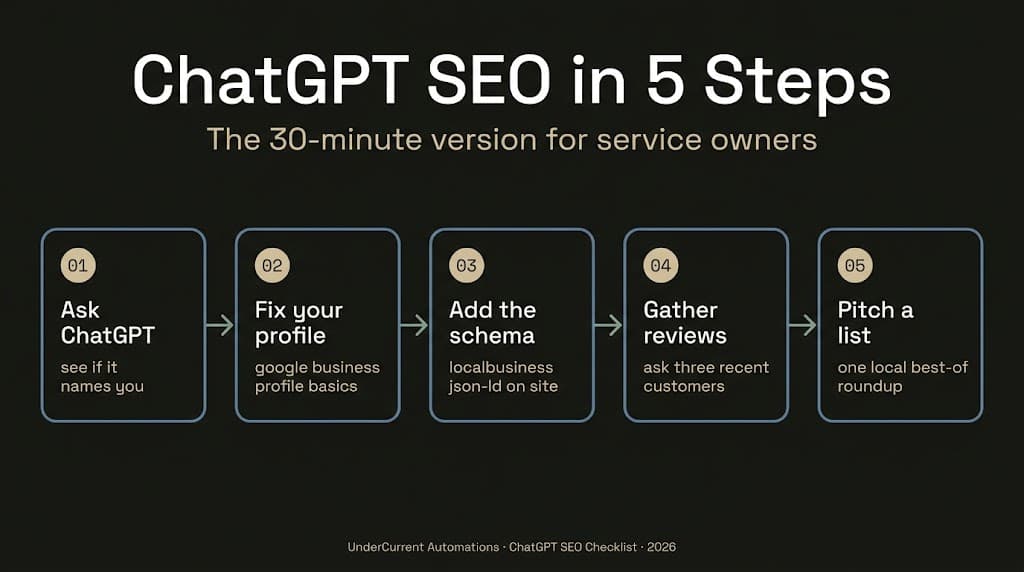
Here is the 30-minute run, in the order I would do it for a business that has never touched ChatGPT SEO. Set a timer. Nothing needs a developer except step three, and that's copy-paste.
The 30-minute run
- Check your baseline. In a fresh chat, ask ChatGPT "best [your trade] in [your suburb]" and a couple of variations. Note if you're named and whether the facts are right, 5 minutes
- Tidy your Google Business Profile. Confirm your name, primary category, service area, phone, hours, and website, then add a few recent photos. It's one of the most reliable sources ChatGPT pulls from for local picks, 8 minutes
- Add LocalBusiness schema. Paste the snippet from the next section onto your homepage and swap in your real details, 7 minutes
- Trigger three fresh reviews. Text three recent customers a one-line ask with your review link. Recency beats volume, 5 minutes
- Pitch one local list. Find one "best [trade] in [city]" roundup and send the author a short, specific pitch, 5 minutes
Steps two and three move the most weight for the least effort, so if you only have 10 minutes, do those. Afterwards, run our free AI search audit or the SEO self-check for Australian businesses to see what's left.

How Do You Add the Schema That ChatGPT Reads?
Schema markup is a small block of structured data in your page's code that spells out, in machine-readable terms, what your business is, so crawlers don't have to guess. For a service business the type you want is LocalBusiness, or a more specific sub-type like Plumber, Electrician, or Accountant. Paste this into your homepage, replace every value with your real details, and you're done:
{
  "@context": "https://schema.org",
  "@type": "Plumber",
  "name": "Your Business Name",
  "url": "https://yourbusiness.com.au",
  "telephone": "+61 3 9000 0000",
  "areaServed": ["Brunswick", "Coburg", "Northcote"],
  "address": {
    "@type": "PostalAddress",
    "addressLocality": "Brunswick",
    "addressRegion": "VIC",
    "addressCountry": "AU"
  },
  "aggregateRating": {
    "@type": "AggregateRating",
    "ratingValue": "4.9",
    "reviewCount": "128"
  },
  "openingHours": "Mo-Fr 07:00-17:00"
}
Two notes. Keep name, telephone, and address identical to your Google Business Profile and your website footer, because mismatched details are the single most common reason a business looks unreliable to an AI engine. And only claim an aggregateRating if it is real and visible on your site, since invented ratings are against the rules and easy to catch. On a builder like Wix, Squarespace, or Shopify there is usually a code-injection field for this; if not, your web person can add it in minutes. After that, the entity work rolls into the wider job of AI search visibility for Australian businesses.
How Do You Check If ChatGPT Already Recommends You?
Open ChatGPT, ask it the questions your customers actually ask, and write down where your name turns up and where it doesn't, that's the whole test. Don't ask "is my business good". Ask the buying questions: "best plumber in Brunswick", "emergency electrician near Coburg with good reviews", "who fixes hot water systems in Melbourne's inner north", "is [your business name] any good". Run about 25 of these over 20 minutes, mixing suburbs, problems, and phrasings, because the answer shifts with the wording. You will land in one of three buckets: named and described correctly, not named at all, or named with wrong details, which is the worst because it actively misleads people. If you want a tool to point ChatGPT at the work itself, it's genuinely useful for sketching the questions customers ask, and its deep-research mode can pull a competitor breakdown for context.
That 25-query sweep is exactly what we run as a free ChatGPT visibility check: we put 25 real customer questions to ChatGPT, screenshot every answer, and show you where you are missing and which fix closes the gap fastest. Prefer to DIY it? The same logic powers our free AI search audit. Either way, the rule holds: you can't fix a gap you haven't measured.
What Surprised Us Auditing 69 Australian ChatGPT SEO Articles
We reviewed 69 published articles from 37 Australian websites that target ChatGPT SEO and AI search, scored them on the UnderCurrent Article Reviewer, and honestly, the spread was wider than I expected. Fewer than 1 in 7 of those articles cleared 80 out of 100. From our wider audit corpus of 146 articles, the ChatGPT-and-AI-search slice averages 59 out of 100, while our own articles on the same rubric average 81. The gap we keep finding is the same: the bar isn't high, most published content just isn't clearing it.
Three things stood out
- Length wasn't the signal: some of the lowest-scoring pieces were the longest, padded with definitions nobody searched for.
- The cheap wins were the ones people skipped: a direct answer up top, consistent business facts, a real citation or two. Those are the same gaps a basic AI search self-check flags, and the ones that take minutes to fix.
- When we look at how our own blog posts get cited by AI tools, the pages that earn mentions are the plain, well-sourced ones.
The full benchmark is in the data behind the best AI search agencies in Australia and a guide to comparing AI search agencies.
What's the Fastest Way to Start Showing Up in ChatGPT Answers?
Do steps two and three from the checklist today, this afternoon if you can, because consistent business facts plus a clean Google Business Profile flip you from "not in the answer" to "in the answer" faster than anything else. Everything after that compounds. Once your identity is tidy, line up reviews on a schedule rather than in a panic: a couple of fresh ones every 2 weeks keeps you looking active, which is what AI engines read as "people use this business". Then chase one new third-party mention every 4 weeks, because those are the slow-burn signal that genuinely moves you up a recommendation.
If you run a trades or home-services business, the same play applies, and our case study with plumbers in Melbourne's south-east is it in practice: tidy the identity, build the review habit, earn the mentions. The honest timeline is weeks, not days, but the work is small and you do most of it up front, so the sooner you start, the sooner you're in the answer. The 2026 SEO advice for Australian small businesses lands in the same place: do the housekeeping, skip the hacks.
Where Does ChatGPT SEO Fit in Your Wider Search Strategy?
Treat ChatGPT SEO as one shelf in the same cupboard as Google SEO and answer engine optimisation, not a separate project, because the same clean content and consistent facts feed all of them. A page that leads with a direct answer, states plain facts, cites real sources, and carries proper schema does double duty: it can rank in Google, get pulled into an AI Overview, and get quoted by ChatGPT or Perplexity off the same words. That's why the AEO work in what answer engine optimisation actually is overlaps so heavily with this guide, and why a niche like buyers' agents runs the same play, as we covered in how to rank a buyers agency on AI search in Melbourne and GEO for buyers agents in Australia.
For a single map of the whole space, that is what our AI search visibility service and the AI search visibility hub for Australia are for, and you can read about who we are if you would rather hand it over. The headline doesn't change: ChatGPT SEO is mostly housekeeping, done consistently, and the businesses that win are the ones that bother to do it.
Sources
- Semrush: ChatGPT traffic analysis
- ROI: ChatGPT advertising in Australia, what's coming
- First Page Sage: ChatGPT usage statistics
- ROI: ChatGPT in Australia: usage, context and practical impact
- Australian Bureau of Statistics: AI transparency statement
- Information Age (ACS): ABS used ChatGPT to write ANZSCO job descriptions
- The Treasury: government getting high-quality results from AI
- arXiv: ChatGPT vs Google: a comparative study of search performance
- Rankmax: local SEO statistics
- Aidan Coleman: AI SEO statistics for 2026
- ClickRank: ChatGPT for keyword research
- SE Ranking: ChatGPT deep research for SEO
- Grand Cru Digital: 2026 SEO tips for Australian small businesses
Frequently asked questions
Is ChatGPT SEO the same as GEO, AEO, and AI SEO?
Mostly, yes. ChatGPT SEO, generative engine optimisation (GEO), answer engine optimisation (AEO), and AI SEO all describe the same job: structuring your online presence so AI tools name your business and state correct facts about it. ChatGPT SEO just narrows the focus to ChatGPT, which matters because it's the most-used tool. The work that helps you there, consistent details, recent reviews, real citations, schema, helps you across Perplexity, Gemini, and Google AI Overviews too.
Does ChatGPT SEO work for a brand-new website with no traffic?
Yes, and arguably it matters more. ChatGPT doesn't need months of Google traffic before it'll mention you; it needs consistent, credible signals it can find: a complete Google Business Profile, accurate details across directories, a few genuine reviews, and a clear, schema-tagged website. A new business with tidy fundamentals can be named in ChatGPT answers well before it ranks on page one of Google, because the model is pattern-matching trust signals, not counting your history.
Do I need a different content strategy for ChatGPT, Perplexity, and Google AI Overviews?
Not really. The same principles win across all three: lead each section with a direct answer, keep facts plain and specific, cite credible sources with real links, and add schema, the basics covered in AI search optimisation for Australia. The edges differ: Perplexity leans on freshness and citations, ChatGPT leans on broad consensus and training data, and AI Overviews stays closest to traditional Google signals. Build the content well once and you cover all three.
How long does it take to show up in ChatGPT answers?
Plan for weeks, not days. If ChatGPT can browse the live web during a query, fresh changes like a corrected Google Business Profile or new reviews can surface fairly quickly. Changes that depend on training data, like being newly mentioned across the web, take longer to filter through, often a few months. A realistic expectation for a service business doing the basics well is meaningful improvement within 8 to 16 weeks, faster if your category isn't crowded.
Can ChatGPT actually read my website, or does it only know what it was trained on?
Both, depending on the mode. When ChatGPT search or browsing is active, it can fetch and read live pages, including yours, in real time. When it answers from memory alone, it relies on what it learned during training plus the patterns in how the wider web describes you. That is why two things matter at once: a clean, current website and schema for the live-fetch path, and consistent mentions and details across the web for the from-memory path. Cover both.
Can I do ChatGPT SEO myself, or do I need an agency?
You can do the 30-minute checklist yourself, and most service owners should start there before paying anyone. The basics, a tidy Google Business Profile, consistent details, a steady review habit, schema, one outreach pitch a month, aren't technical work. Outside help earns its keep on scale and consistency: running the 25-query check properly, fixing schema across a bigger site, chasing mentions, tracking what moves. If you've got the half-hour, do it; if you don't, that's when a hand helps.