

What is Answer Engine Optimisation? A Plain-English Guide
Quick answer
Answer engine optimisation makes your business one of the three citations an AI gives a buyer, instead of one of ten blue links.
- The work is structural: clear definitions and schema markup
- Citation-friendly sources and weekly tracking
- Good Google rankings often come with zero AI citations
- The fix is repeatable, and citations now beat clicks

Your customer asks ChatGPT for a recommended Sydney accountant, an Adelaide buyers agent, or a Brisbane plumber, and an answer comes back in three sentences. No ten blue links. No scrolling. One name gets quoted, the rest don't exist. That's the new front door of buyer search, and answer engine optimisation is the work of being the business that gets quoted.
If you've spent the last decade chasing Google rankings, AEO is the discipline that decides whether your work still pays off. About 49% of Australians used a generative AI tool in the past year, and the share is climbing every quarter. We've audited 32 Australian articles ranking for AI search keywords against our 100-point UnderCurrent Article Reviewer rubric (version 2.0.0), and the spread between visible businesses and invisible ones is wider than you'd think. Ahrefs' breakdown of AEO lays out the same retrieval shifts at a global level. This guide unpacks the field for owners who want a real answer, not a sales pitch.
What is answer engine optimisation, in plain English?
Answer engine optimisation is the practice of structuring your website, your content, and your off-site footprint so that AI tools quote your business when a customer asks them a question. The "answer engines" are products like ChatGPT, Perplexity, Google's AI Overviews and AI Mode, Gemini, and Claude. They read the open web, decide which sources are trustworthy and relevant, and stitch together a short reply, often with two or three citations underneath. AEO is the deliberate craft of becoming one of those citations, instead of being scrolled past in a list of ten. HubSpot's AEO guide frames it as "optimising for the question, not the keyword", and that's a useful one-line summary. The work spans schema markup, citation-friendly writing, first-party data, brand mentions across the open web, and the technical plumbing that lets a model parse your page in under a second. If your business has ever ranked on Google, you have a head start. You don't have a finished job. AEO is a different game with different signals, and most Australian small businesses haven't started playing.
How is answer engine optimisation different from SEO?
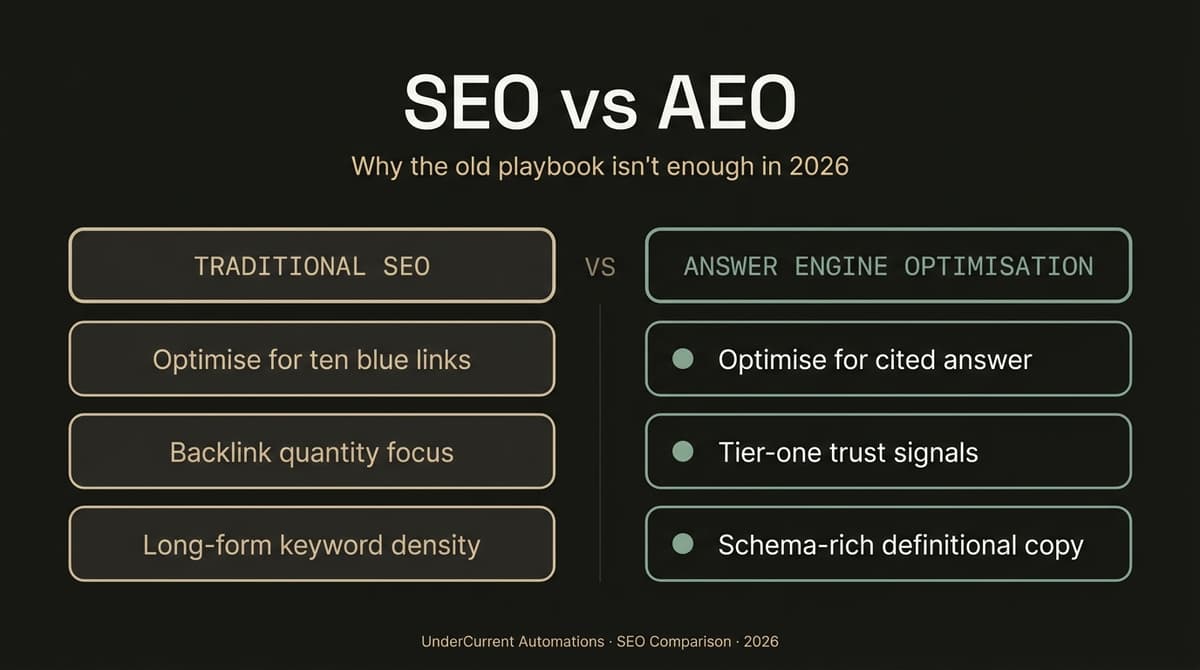
Traditional SEO optimises for clicks. AEO optimises for being cited inside an answer the customer often won't click through. That single shift changes almost everything downstream. SEO rewards keyword density, backlink volume, and ranking on page one. AEO rewards a clear definitional sentence near the top of a page, structured data the model can parse, named entities the model recognises, and citation-worthy facts an AI can quote without summarising you into mush. Roughly 65% of Google searches now end without a click globally, with Moz's industry tracking corroborating the zero-click trend, and the trend is accelerating. The other big shift is feedback loops. SEO has Google Search Console, ten years of dashboards, and clear rank tracking. AEO citation tracking is still being built, which means the businesses winning today are the ones running their own AI search self-checks instead of waiting for tools to catch up. Closely related but not identical: AI search optimisation more broadly covers the surface area. AEO is the answer-extraction subset.
Why answer engine optimisation matters for Australian businesses right now
The economics of search are changing faster in Australia than the average board paper acknowledges. About 74% of Australians have used a generative AI tool in the past year per Google and IPSOS data, backed by SEMrush's mid-2025 AEO industry analysis, and projections show that share heading toward 80% with monthly use becoming default behaviour for under-40s by 2027. Australian digital marketing budgets are forecast to climb from $14 billion to $16 billion in AUD terms, and roughly 70% of Australian companies are reallocating spend toward digital channels. The money is moving toward digital channels, and the way buyers actually get an answer is shifting from a results page to a model's reply. If your business pulls leads from search, the question isn't whether to invest in AEO, it's whether to start now or after a competitor has already locked in citations on the questions that drive your phone to ring. We see the gap most clearly in mid-tier service businesses across Melbourne, Sydney, Brisbane, Perth, and Adelaide, where Google rankings are decent but AI citations are zero.
What signals do AI engines use to pick their answers?
AI engines pull from a small set of signals every time they answer a query, and you can engineer for each one. First, semantic match: the model needs to be sure your page covers the question being asked, which means a clear answer in the first sentence of the section, not buried under three paragraphs of context. Second, source trust: domain authority still matters, plus published author credentials and brand mentions across tier-one Australian and global sources. Third, schema and structure: FAQ schema, Article schema, and clean H2 hierarchy let a model extract a citable chunk in milliseconds. Fourth, freshness: pages updated in the last six months get pulled more often than evergreen pages last touched in 2022. The four signals are simple to list. They're harder to execute consistently, especially across a 60-page service site where most pages were written for human readers, not for an extraction model that needs precise definitions and named entities to do its job.
Where AEO shows up: ChatGPT, Perplexity, Google AI Overviews, Gemini
The four answer engines worth tracking right now are ChatGPT (OpenAI), Perplexity, Google's AI Overviews and AI Mode, and Gemini. Google's AI Overviews now appear above the standard results for the majority of informational queries, and the trigger pattern is heavily weighted toward "what", "how", and "should I" questions. ChatGPT pulls from its own training data plus live web search, with citation rendering that has matured significantly in the last year. Perplexity is the most citation-forward of the four, listing three to seven sources directly under its answer and surfacing source quality cues. Gemini sits inside Google's broader stack and shares retrieval signals with AI Overviews. The practical implication: every AEO project needs to track citations across all four, not just one. A page that gets quoted in Perplexity but ignored by ChatGPT is leaking pipeline. Search Engine Land's coverage of AI Overview integration tracks the rollout pace closely, and tracking AI citations on a recurring basis is now baseline hygiene, not a stretch goal.
What surprised us when we audited 32 Australian AI search articles
Three things hit harder than the score sheet alone shows. First, the spread is enormous. Across 32 articles from 20 distinct hosts, the mean rubric score is 60.1 out of 100, with a range from 30 to 90, a 60-point spread on the same yardstick. Second, the shape of the distribution is rough: 6 articles earned a Strong score (80+), 8 sat in the Competent band (60-79), and 18 (more than half) landed in the Weak band (30-59). On a 145-article whole-corpus benchmark across verticals the average is 52.6, which means AI-search content as a category is rougher than most niches we've looked at. Third, when we ran our own ten articles through the same rubric, the mean score was 80.5. That gap isn't a brag, it's a process tell. The 30-minute fixes (FAQ schema, definitional sentence, citation tightening) carry most of the lift.
The 5-step AEO playbook for Australian small businesses
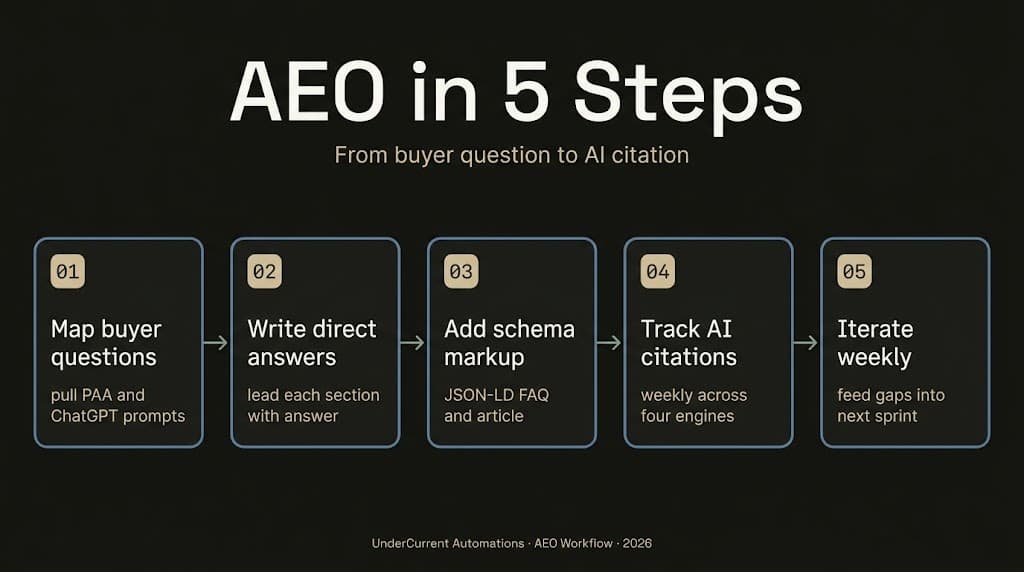
Working backwards from what actually moves the score sheet, the playbook comes down to five steps.
The five steps, in order
- Map the questions a buyer asks before they buy: pull People Also Ask data, scrape ChatGPT for the same query, and list every adjacent question.
- Write a tight definitional answer in the first 80 words of every page that targets one of those questions.
- Mark up FAQ blocks, Article schema, and Organization schema using Schema.org vocabularies.
- Layer in first-party data: original observations, internal benchmarks, named clients (with permission), and specific dollar figures from your own operations.
- Track citations weekly across ChatGPT, Perplexity, Gemini, and Google AI Overviews, and feed the gaps back into the next round of edits.
None of the five steps require a six-figure tool stack. They require a clear weekly cadence and a structured AI search audit you actually run.
For step three, the minimal FAQ block looks like this:
{
  "@context": "https://schema.org",
  "@type": "FAQPage",
  "mainEntity": [{
    "@type": "Question",
    "name": "What is answer engine optimisation?",
    "acceptedAnswer": {
      "@type": "Answer",
      "text": "Answer engine optimisation is the practice of structuring content so AI tools cite your business when buyers ask them a question."
    }
  }]
}
Should you do answer engine optimisation yourself or hire help?
The honest answer depends on the hours you can give it and how technical your team is. DIY works when the owner is hands-on and willing to spend several hours per week on schema and content edits. A hybrid approach, where you pay for an audit then run the work yourself, suits service businesses with limited ops capacity. Full agency partnership makes sense when the cost of absence is bigger than the retainer.
| Approach | Setup time | Monthly spend | Best for |
|---|---|---|---|
| DIY AEO | 4-6 hrs/wk ongoing | $0-$200 in tools | Technical owners |
| Hybrid (audit then DIY) | 4 hrs/mo | One-off implementation fee, scoped at the start, + tool stack | Limited ops capacity |
| Full agency partnership | 2 hrs/mo on review calls | Around $500-$2,000/mo with UnderCurrent; A$2,000-$10,000/mo per Titan Blue | AI search as a sales channel |
Most owners sit in the hybrid lane for the first six months. If you're comparing Australian AI search agencies, shortlist on citation evidence, not slide decks. Search Engine Journal's review of AEO methodology is a useful sense-check.
How long does AEO take to show measurable results?
Expect first citations within four to eight weeks if your domain already has reasonable authority and indexing is healthy. Expect twelve to sixteen weeks before AI citations start producing measurable lead volume. The honest version: AEO is faster than traditional SEO because the AI engines re-crawl frequently and respond to schema and definitional rewrites within days, not months. It is slower than ads because the citation graph compounds rather than spikes. Two checkpoints we use with clients: at week six, you should be cited at least once for a tracked question. At week twelve, the citation graph should cover three to five tracked questions across at least two of the four major engines. Sites under those numbers usually have either a trust-signal gap or a structural-data gap, and both are diagnosable in an afternoon. If you're shaped like an early UC client, you'll have your first citation in the first month. The 30-minute fixes carry that distance.
Frequently asked questions
How much does answer engine optimisation cost in Australia in 2026?
UnderCurrent prices AEO case by case. Expect to pay around $500 to $2,000 a month, depending on the work needed, plus a one-off implementation fee for the audit and schema work, scoped at the start. Prices exclude GST. Titan Blue, a Gold Coast agency, puts typical Australian SEO spend higher, at A$2,000 to A$10,000 a month, with enterprise work above A$15,000. Tooling alone, if you DIY, sits at $40 to $300 per month depending on whether you're tracking a single location or a multi-site footprint.
Which AI engines does AEO target, ChatGPT, Perplexity, Google AI Overviews?
The four worth tracking today are ChatGPT (OpenAI), Perplexity, Google's AI Overviews and AI Mode, and Gemini. Claude is increasingly relevant for B2B research queries. The four overlap on retrieval signals, but each weights citation differently, which is why a page can get cited in Perplexity and missed by ChatGPT. A serious AEO program tracks all four on a weekly cadence and writes the gaps into the next sprint. Tracking only Google AI Overviews understates how much of buyer research has moved to direct ChatGPT and Perplexity sessions.
Do I need AEO if my Google rankings are already good?
Yes, with a caveat. Strong Google rankings give you a head start on domain authority and indexing, both of which feed AI retrieval. They don't guarantee citations. The page structures Google rewards (long-form, keyword-dense, FAQ-light) are not the structures answer engines prefer (definitional, schema-rich, citation-friendly). Most Australian businesses we audit rank decently on Google and earn close to zero AI citations on the same queries. The fix is structural, not strategic, and the AI search vs traditional search comparison lays out exactly what changes.
Can a small business do answer engine optimisation without an agency?
Yes, if the owner is hands-on, comfortable editing markdown and JSON-LD, and able to spend four to six hours per week on the work. The technical bar is lower than people think. The discipline bar is higher. The DIY path that works in practice is to start with one cluster of pages that map to your highest-margin services, run a structured self-audit against a tracked rubric, fix the obvious structural gaps, and repeat the loop monthly. The path that fails is doing scattershot tactical edits across the whole site without a tracked rubric.
Is AEO worth it for a small Australian service business?
Almost always yes, with a caveat about timing. If you're a sole trader doing fewer than five enquiries a week from search, the immediate ROI is muted, and your money is better spent on local SEO and Google Business Profile work first. If you're a growing service business with a real sales pipeline that depends on inbound search, AEO is now table stakes, not a luxury. The cost of being absent from AI answers compounds quietly. By the time it shows up in your reporting, a competitor has already taken the citation slot, and citations are stickier than rankings.
Will AEO replace SEO, or do I still need both?
Both, for at least the next three to five years. Traditional SEO still drives the click-bearing portion of search, the comparison and decision-stage queries where users want to compare three options, and the long-tail commercial queries where AI engines defer to organic results. AEO captures the question-shaped queries that increasingly resolve inside the answer. The smart move is to treat them as one program, not two: every page should rank on Google and be citable in ChatGPT. The plumbing is shared, and the writing differs.