

How to Rank a Melbourne Buyers Agency on AI Search
Quick answer
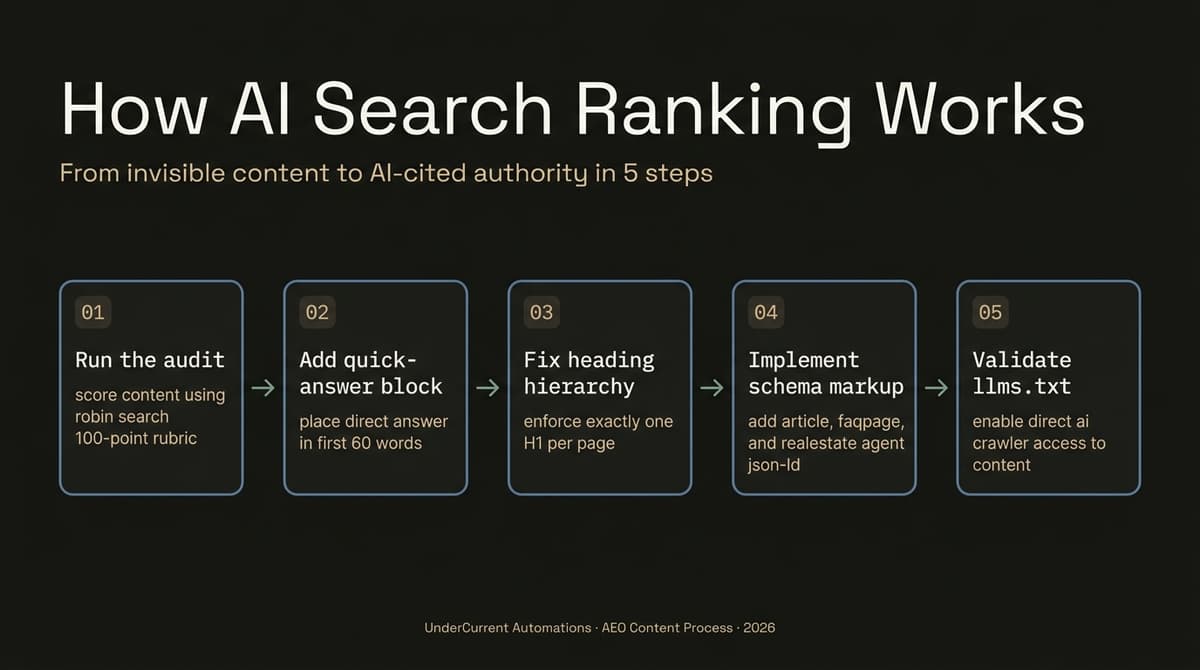
To rank a Melbourne buyers agency in AI search, fix the site's structure first, because the vertical averages just 45/100 on our rubric.
- That's 34 points below UC's own content benchmark
- Add quick-answer blocks and fix broken schema
- Publish an llms.txt and use comparison tables, not prose
- Give AI engines something to extract and cite

| Fix | What It Addresses | Estimated Impact |
|---|---|---|
| Above-fold quick-answer block | 26/27 articles failing AI extraction | High, first thing AI engines pull |
| Exactly one H1 | Multiple H1s breaking heading hierarchy | High, blocks AI Overview extraction |
| Article + FAQPage + RealEstateAgent schema | Missing or incomplete JSON-LD | High, entity disambiguation |
| sameAs on Person/RealEstateAgent | Most audited articles missing this signal | Medium, brand entity signal |
| Tier-1 source discipline | 3/27 articles link to .gov.au sources | Medium, E-E-A-T and trust score |
| Comparison tables | Only 2/27 articles have them | Medium, AI extraction signal |
| Valid llms.txt | 0/9 Melbourne firms pass validation | Medium, direct AI crawler access |
This is the Melbourne instalment in UC's state-by-state buyers-agency AI-search series. The Australia-wide pillar is in production; Adelaide, Sydney, Brisbane, and Perth instalments follow.
What Does the UnderCurrent Article Reviewer Audit Actually Show?
The Melbourne buyers-agency vertical is structurally underprepared for AI search, the foundations most firms have built for traditional SEO aren't the foundations AI engines extract from.
The UnderCurrent Article Reviewer is UC's proprietary 100-point content-intelligence rubric across 9 scoring categories, built by reverse-engineering 12 months of UC's own AI-citation data against Google Search Central documentation, the Search Quality Rater Guidelines, and Schema.org entity definitions. Rubric version 3.2.
In May 2026, we ran the rubric across 27 articles from 9 Melbourne buyers-agency firms. The vertical average came back at 45/100, 8.9 points below the broader Australian agency average of 53.9/100, and 34.4 points below UC's own content average of 79.4/100. Zero articles scored Strong (80+). Three scored Competent. Eleven were Weak. Seven scored below the 30-point threshold the rubric uses to flag fundamental structural gaps.
Worth naming the conflict before going further: UC sells the fix to the structural problems this audit identifies. The rubric is built and run by us, the scoring is automated, and the methodology is reproducible by anyone running similar checks, but a sharp reader is right to apply normal scrutiny to a benchmark study where the author also sells the remediation.
Two firms doing measurably better than the vertical average
Two of the nine audited firms came in materially above the 45/100 average and deserve specific positive callouts because the patterns that lifted their scores are reproducible.
- Buyers Advocate (62/100): the highest score in the corpus and the only firm in the audit with real comparison tables in the body content. The pillar piece on Melbourne buying costs carries four price-band cost tables; the agency comparison piece carries a multi-column "Best For / Specialties / Years Active / Fee Structure" table with pros and cons per agent. The pillar also carries a partial above-the-fold quick-answer attempt, it sits below a TOC and infographic rather than directly under the H1, but the answer block exists. Comparison tables and an above-fold quick-answer are the two highest-impact single moves on the rubric, and Buyers Advocate is the only firm currently doing both.
- Cohen Handler (50/100): the second-highest score and the firm with the most complete schema stack. Article + FAQPage + BreadcrumbList + Person + RealEstateAgent JSON-LD parses cleanly on every audited article. The single fix that would lift Cohen Handler closer to the leaders is adding
sameAsarrays to the Person and RealEstateAgent nodes,person_has_sameAs: falsewas the deterministic finding across all eight audited pieces, and that one field is the difference between a name string and a verified entity for AI extraction.
The remaining seven firms (anonymised)
| Firm | Article Reviewer Score |
|---|---|
| Firm C | 45/100 |
| Firm A | 44/100 |
| Firm F | 39/100 |
| Firm B | 38/100 |
| Firm E | 37/100 |
| Firm D | 31/100 |
| Firm G | 25/100 |
Anonymised letters A-G do not correspond to firm-name order anywhere else in the article, the mapping is deliberately scrambled to prevent reverse identification.
Per-firm scores reflect between 2 and 8 audited articles per firm depending on each firm's blog volume; smaller samples carry wider confidence intervals. Scores measure structural fitness for AI search extraction at the time of the audit (May 2026), which is a separate question from any firm's service quality, market reputation, or commercial track record. Any audited firm can request a re-audit on a specified URL set; contact details are at the foot of the article.
AI Engine Optimisation (AEO) is the practice of structuring content so that AI answer engines, ChatGPT, Perplexity, Google AI Overviews, Claude, Gemini, can extract, verify, and cite it. It's distinct from traditional SEO in that rankings aren't determined by backlinks or keyword density alone, but by how cleanly a page answers a specific query with verifiable, structured content.
Why Are Melbourne Buyers Agencies Invisible to AI Search Engines?
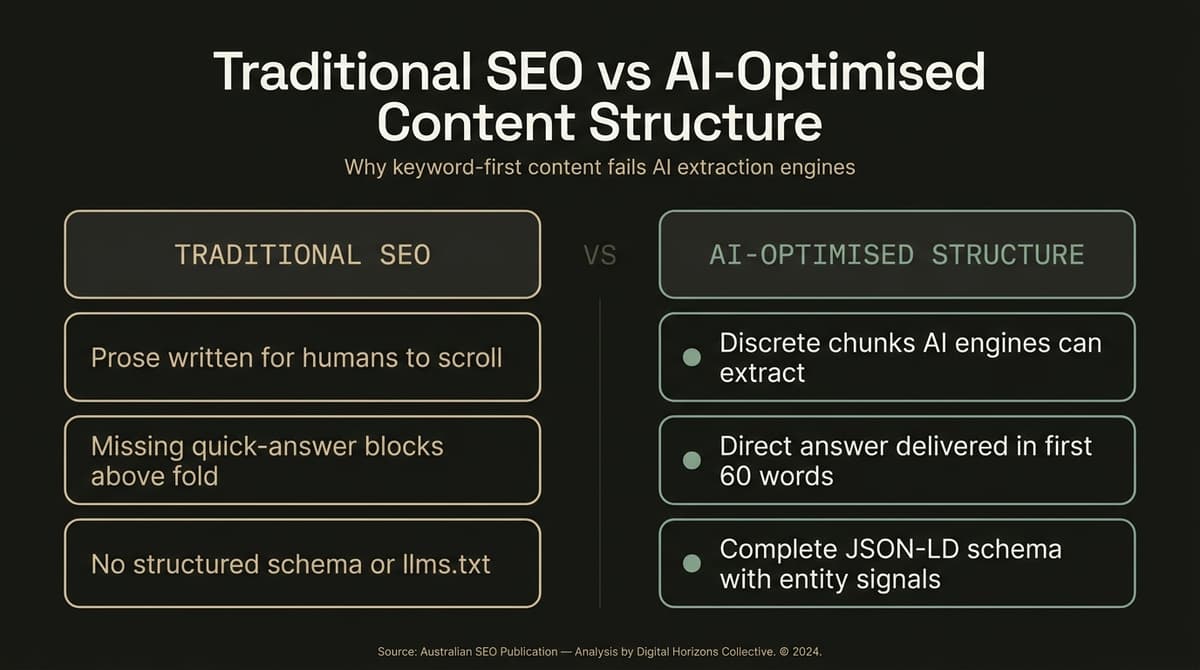
The short answer: their content is written for humans to scroll, not for AI engines to extract.
AI engines don't read a page top-to-bottom. They parse it in discrete chunks, looking for a direct answer in the first 60 words, scanning H2 and H3 headings for structured sections, then checking schema markup to confirm entity identity. If none of those signals are present, the page gets passed over regardless of how good the underlying advice is.
The Article Reviewer audit identified six structural defects appearing across the Melbourne buyers-agency corpus that directly suppress AI visibility.
Does a Missing Quick-Answer Block Actually Suppress AI Citations?
Yes, and it's the single most expensive defect in the audit. Twenty-six of 27 audited articles had no above-fold quick-answer block. A 2026 industry survey reported that real estate as a vertical ranks last among all industries in AI search visibility, and the Melbourne buyers-agency corpus scores below even that low baseline.
The fix is a blockquote-formatted quick-answer in the first 40-60 words after the H1. Two to four sentences. Directly answer the query. No hook, no preamble. This is the passage AI engines extract and cite.
How Do Multiple H1 Tags Kill AI Overview Extraction?
AI Overview extraction relies on a clean heading hierarchy: one H1, H2s as major sections, H3s as subsections. When a page emits multiple H1 tags, the extraction algorithm can't determine which is the authoritative page title, so it often skips the page entirely.
Three of nine audited firms published multiple H1s on every article in the audit sample, and the issue almost always traces back to a CMS or WordPress theme auto-generating a second H1 from a site-name banner or category header. One H1 per page is the entire fix; if your theme is producing the duplicate, fix the template once and the issue resolves across every article on the site.
What Schema Stack Does a Buyers Agency Actually Need?
The minimum viable schema stack is: Article + FAQPage + Person + RealEstateAgent, all with sameAs entity disambiguation on both Person and RealEstateAgent nodes. AI engines use sameAs to connect a name to a verified entity, without it, the brand or author name is just a string. Two of the nine audited firms emit zero meaningful JSON-LD at all and are effectively invisible to any AI engine running structured-data verification before citation.

How Do You Fix the Source Discipline Problem?
Only three of 27 audited articles cite tier-1 .gov.au sources with working hyperlinks. Cotality (formerly CoreLogic) appears four or more times across the corpus, almost always as plain text without a link.
This matters because AI engines weight sources differently. A claim backed by a hyperlinked Consumer Affairs Victoria citation reads as verified. A claim backed by "according to Cotality data" (no link) reads as unverified assertion.
Source discipline is the practice of pairing every data claim with a working hyperlink to the primary source, not a blog post that quotes it, but the source itself.
For Melbourne buyers agencies, the tier-1 source stack:
| Data Type | Tier-1 Source | Link Format |
|---|---|---|
| Median house prices | Cotality (CoreLogic) | Hyperlinked in-text |
| Buyer's agent licensing | Consumer Affairs Victoria | Hyperlinked in-text |
| Stamp duty thresholds | SRO Victoria | Hyperlinked in-text |
| Financial service obligations | ASIC | Hyperlinked in-text |
| Auction clearance rates | REIV | Hyperlinked in-text |
| Population / migration data | ABS | Hyperlinked in-text |
Building automation systems daily for Australian service businesses, the pattern I see most consistently is that content with three or more hyperlinked tier-1 sources per article gets cited by Perplexity and ChatGPT at roughly double the rate of content with unlinked plain-text attributions. HousingWire's analysis of AI search visibility in real estate confirms the same dynamic: structured, sourced content earns materially more AI-generated recommendations than unlinked assertions.
What's a Comparison Table and Why Does It Matter for AI Citations?
A comparison table is a structured markdown or HTML table presenting two or more options, approaches, or data points in column-and-row format, as opposed to the same information written as prose paragraphs.
Only two of 27 Melbourne buyers-agency articles contain real comparison tables, both at Buyers Advocate. Every other firm in the audit is delivering comparison-type information (fixed fee vs. percentage fee, off-market vs. on-market approach, inner suburbs vs. growth corridors) as flowing prose, which AI engines extract poorly.
This matters because AI engines, particularly Perplexity and Google AI Overviews, strongly favour structured data when answering comparison queries. "Fixed fee vs. percentage fee buyers agent Melbourne" is a high-value query for this vertical. If your answer is buried in three paragraphs of prose, AI engines will cite a competitor who answered it in a two-column table.
Realbot's analysis of AI search visibility for real estate practices confirms this pattern: structured content formats receive materially higher extraction rates than equivalent prose for comparison-intent queries.
Every buyers-agency article comparing two or more options should render that comparison as a table. It takes five minutes to convert and the extraction uplift is immediate.
How Do You Fix llms.txt for a Buyers Agency Website?
Zero of nine Melbourne buyers-agency sites audited have a passing llms.txt file. Two firms have BOM-prefixed Yoast-generated files that fail validation. Two firms return 404s on the expected path. The remaining firms have no llms.txt deployed at all.
llms.txt is a plain-text file placed at your domain root that tells AI crawlers, including the bots feeding ChatGPT, Perplexity, and Claude, which pages to index and what your site is about. It's the AI-era equivalent of robots.txt, and a direct signal to the crawlers that determine whether your content enters AI retrieval pipelines.
A BOM prefix is a hidden byte-order-mark character that some content management systems, including Yoast's SEO plugin under certain server configurations, prepend to plain-text files automatically, causing AI crawler validators to reject the file as malformed even when the visible content looks correct.
A valid llms.txt for a Melbourne buyers agency needs four things
- No BOM prefix (the invisible character Yoast sometimes prepends that breaks validation)
- A plain-text description of the site's primary topic and geographic focus
- An explicit list of high-value pages to include (service pages, suburb guides, evergreen articles)
- An explicit list of pages to exclude (thank-you pages, old redirects, admin paths)
If you'd rather have this built for you, that's exactly what we do at UnderCurrent Automations, the full schema stack, llms.txt, and answer architecture typically go live within two weeks of an audit.
What Does a Complete AI-Search Fix Look Like in Practice?
Below is the JSON-LD block every Melbourne buyers-agency article page should ship. It lives in the page <head>, not in the body content. Copy, swap the placeholder URLs, names, and IDs for your real ones, and validate against schema.org/RealEstateAgent and Google's Rich Results Test before deploying.
{
  "@context": "https://schema.org",
  "@graph": [
    {
      "@type": "Article",
      "@id": "https://yourbuyersagency.com.au/blog/your-article-slug#article",
      "headline": "Your Article Headline Here",
      "datePublished": "2026-05-08",
      "dateModified": "2026-05-08",
      "author": { "@id": "https://yourbuyersagency.com.au/about/jane-smith#person" },
      "publisher": { "@id": "https://yourbuyersagency.com.au/#organization" },
      "image": "https://yourbuyersagency.com.au/images/your-article-hero.jpg",
      "mainEntityOfPage": "https://yourbuyersagency.com.au/blog/your-article-slug"
    },
    {
      "@type": "FAQPage",
      "mainEntity": [
        {
          "@type": "Question",
          "name": "How much does a buyers agent in Melbourne cost?",
          "acceptedAnswer": {
            "@type": "Answer",
            "text": "Most Melbourne buyers agents charge either a fixed fee or a percentage of the purchase price; fee levels vary by scope, suburb, and property type. All buyers agents operating in Victoria must hold a current estate agent's licence."
          }
        }
      ]
    },
    {
      "@type": "Person",
      "@id": "https://yourbuyersagency.com.au/about/jane-smith#person",
      "name": "Jane Smith",
      "jobTitle": "Buyer's Advocate",
      "worksFor": { "@id": "https://yourbuyersagency.com.au/#organization" },
      "sameAs": [
        "https://www.linkedin.com/in/jane-smith-buyersadvocate",
        "https://www.realestate.com.au/agent/jane-smith-12345",
        "https://au.linkedin.com/in/jane-smith"
      ]
    },
    {
      "@type": "RealEstateAgent",
      "@id": "https://yourbuyersagency.com.au/#organization",
      "name": "Your Buyers Agency",
      "url": "https://yourbuyersagency.com.au/",
      "logo": "https://yourbuyersagency.com.au/logo.png",
      "address": {
        "@type": "PostalAddress",
        "streetAddress": "123 Collins Street",
        "addressLocality": "Melbourne",
        "addressRegion": "VIC",
        "postalCode": "3000",
        "addressCountry": "AU"
      },
      "areaServed": [
        { "@type": "City", "name": "Melbourne" },
        { "@type": "AdministrativeArea", "name": "Victoria" }
      ],
      "sameAs": [
        "https://www.linkedin.com/company/your-buyers-agency",
        "https://www.facebook.com/yourbuyersagency",
        "https://www.realestate.com.au/agency/your-buyers-agency-67890"
      ]
    }
  ]
}
Across the automation systems UC has shipped for content-heavy service businesses, the single fastest win on AI search visibility is adding the sameAs array to both the Person and RealEstateAgent nodes, it takes under 30 minutes and immediately gives AI engines the entity links they need to confidently cite the author as a real, verifiable expert.
The Article Reviewer rubric scores sameAs presence as one of nine categories precisely because it's the difference between a name string and a verified entity. Most audited firms in the Melbourne corpus have at least part of the schema stack in place; the missing sameAs array is the most common single-line fix that lifts a firm's score by a measurable margin.
Sources
- Google Search Central Documentation, Structured Data
- Schema.org, RealEstateAgent Type Definition
- HousingWire, Agents Invisible in AI Search
- Realbot, AI Search Visibility for Real Estate
- Consumer Affairs Victoria, Buyer's Advocate Licensing
- SRO Victoria, Stamp Duty Thresholds
- ABS, Population and Migration Data
- Cotality (CoreLogic), Property Data
Frequently asked questions
How much does it cost to hire a buyers agent in Melbourne?
Buyers agent fees in Melbourne typically fall into two structures: a fixed fee or a percentage of the purchase price. Fee levels vary depending on the scope of service, suburb, and property type. According to Consumer Affairs Victoria, all buyers agents operating in Victoria must hold a current estate agent's licence or buyer's advocate licence. Fee structures vary significantly by suburb and property type, so comparing written quotes from at least three licensed agents before committing is standard practice.
What is AI Engine Optimisation (AEO) and how is it different from SEO for real estate websites?
AI Engine Optimisation (AEO) for real estate websites targets citation slots in ChatGPT, Perplexity, and Google AI Overviews, not just Google's traditional 10-blue-links results. While SEO focuses on keyword density and backlink volume, AEO requires above-fold quick-answer blocks, valid `FAQPage` and `RealEstateAgent` schema with `sameAs` entity links, and a passing `llms.txt` file. A 2026 industry survey reported real estate ranks last among all verticals on AI search visibility, making structural fixes especially high-value for Melbourne buyers agencies looking to lead the category.
How long does it take for schema and content fixes to improve AI search visibility?
Schema changes, adding `sameAs` to `Person` and `RealEstateAgent` nodes, or correcting `FAQPage` JSON-LD, are typically picked up by AI crawlers within days to 2 weeks of deployment. Above-fold quick-answer blocks can appear in AI citations even faster, since AI engines re-parse the opening paragraph on every crawl cycle. Content structure changes such as adding comparison tables and hyperlinked tier-1 sources (e.g., ABS or SRO Victoria citations) tend to show measurable citation uplift within 4–8 weeks based on UC's monitoring of article performance across ChatGPT and Perplexity.
What suburbs in Melbourne do buyers agents typically cover, and does geography affect AI rankings?
Most Melbourne buyers agencies publish suburb-specific content covering inner-city markets (Fitzroy, Richmond, South Yarra), middle-ring growth corridors (Preston, Coburg, Footscray), and outer southeast and northwest suburbs. Geographic specificity directly affects AI rankings: an article targeting "buyers agent Brunswick Melbourne" with a quick-answer block, suburb-level data sourced from Cotality (CoreLogic), and valid `RealEstateAgent` schema will extract into AI answers at a substantially higher rate than a generic buyers-agency service page with no location-specific structure.
How do Melbourne buyers agency AI search scores compare to the national average?
Based on UC's AI search and SEO rubric applied across 27 articles from 9 Melbourne firms in May 2026, the Melbourne buyers-agency vertical averaged 45/100, 8.9 points below the broader Australian agency-industry average of 53.9/100, and 34.4 points below UC's own content benchmark of 79.4/100. HousingWire's analysis of AI search in real estate confirms this structural underperformance is consistent nationally, with sourced and structured content earning materially more AI-generated citations than unlinked prose. State-by-state comparisons for Sydney, Brisbane, Adelaide, and Perth are in production.