

GEO for Buyers Agents: Win AI Search in Australia
Quick answer
GEO for buyers agents is setting up your site so ChatGPT, Gemini, Perplexity and Google's AI Overviews cite your firm when a buyer asks who's best.
- A direct one-sentence answer at the top of the page
- Schema-marked services and plenty of named entities
- Tier-1 sources cited on every claim
- Win the citation and you win the lead

A note on terminology. GEO for buyers agents in this guide means Generative Engine Optimisation, the AI-search version of SEO. Some real-estate writers use "GEO" as shorthand for geographic targeting. That's not what we mean. We're talking about getting your buyers agency surfaced inside AI answer engines.
The shift matters now because AI use among Australian businesses is climbing fast. The Australian Bureau of Statistics 2024 release reported 24% of Australian businesses with 5–200 employees used AI in 2024, up from 8% in 2022. HubSpot's 2025 APAC business growth report calls GEO "a core marketing channel" across SaaS, eCommerce, corporate services, healthcare, finance, and hospitality. Buyers agents who treat their site like a 2018 SEO play will keep losing leads to firms that show up inside the AI answer itself.
Why you should be skeptical of this article
Worth naming the conflict before going further. UnderCurrent sells the fix to the GEO problems this article points out. The UnderCurrent Article Reviewer rubric we apply is built and run by us. The audit data is ours. The method is reproducible by anyone running the same checks. A sharp reader is right to push on a benchmark argument where the author also sells the fix. Any firm referenced in our audit corpus can request a re-audit on a specified URL set. Contact details are at the foot of the article.
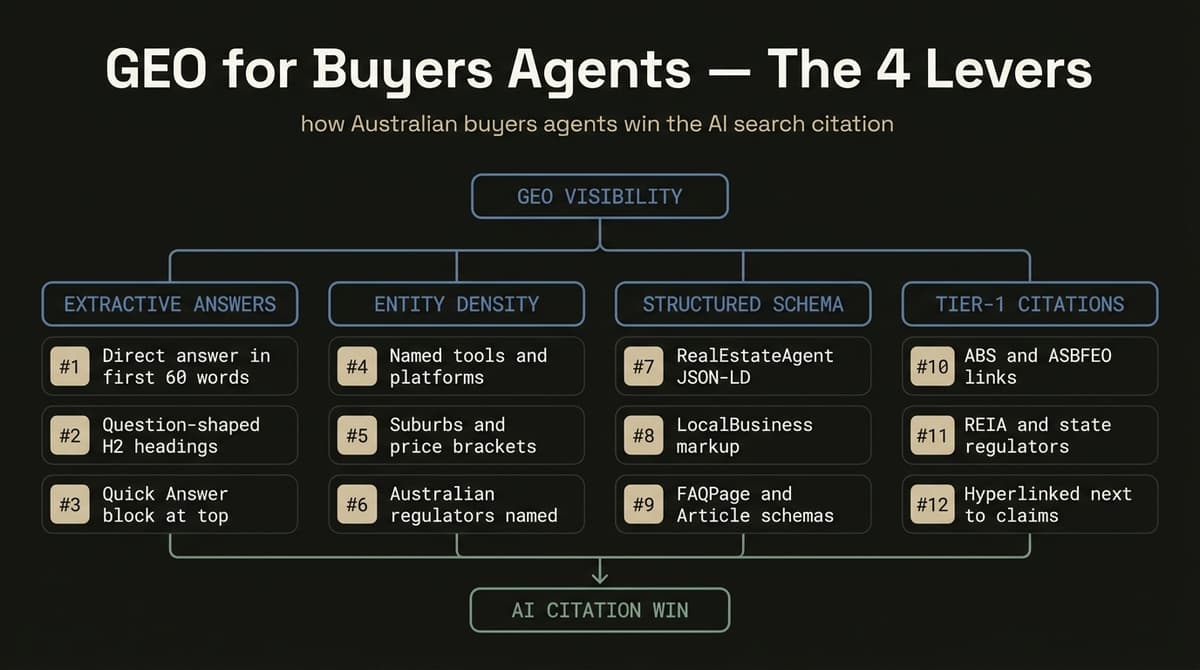
Why does GEO for buyers agents matter right now?
Buyer-agent demand is climbing while AI engines reshape how property buyers research advisors. Involvement in Australian property transactions has roughly tripled since the pandemic, per the InfoTrack 2025 State of Real Estate Report. The same report found about 75% of property buyers did not use a buyers agent at all. Of the 25% who did, only 60% reported above-average satisfaction. The Australian Bureau of Statistics 2024 release reported 24% of Australian businesses with 5–200 employees used AI in 2024, up from 8% in 2022. Most of your future clients are still researching, asking questions you could be answering inside an AI engine.
The same reports flag how research questions land now. AI engines build an answer, name a few firms, and the user picks from that shortlist. If you're not on the shortlist, you don't get the call. That's the whole game.
GEO is your way onto that shortlist. It runs on five levers, all measurable, all fixable in 60–90 days of focused work.
What does GEO for buyers agents actually mean?
GEO is the work of getting your firm cited by name inside the answer an AI engine writes from scratch.
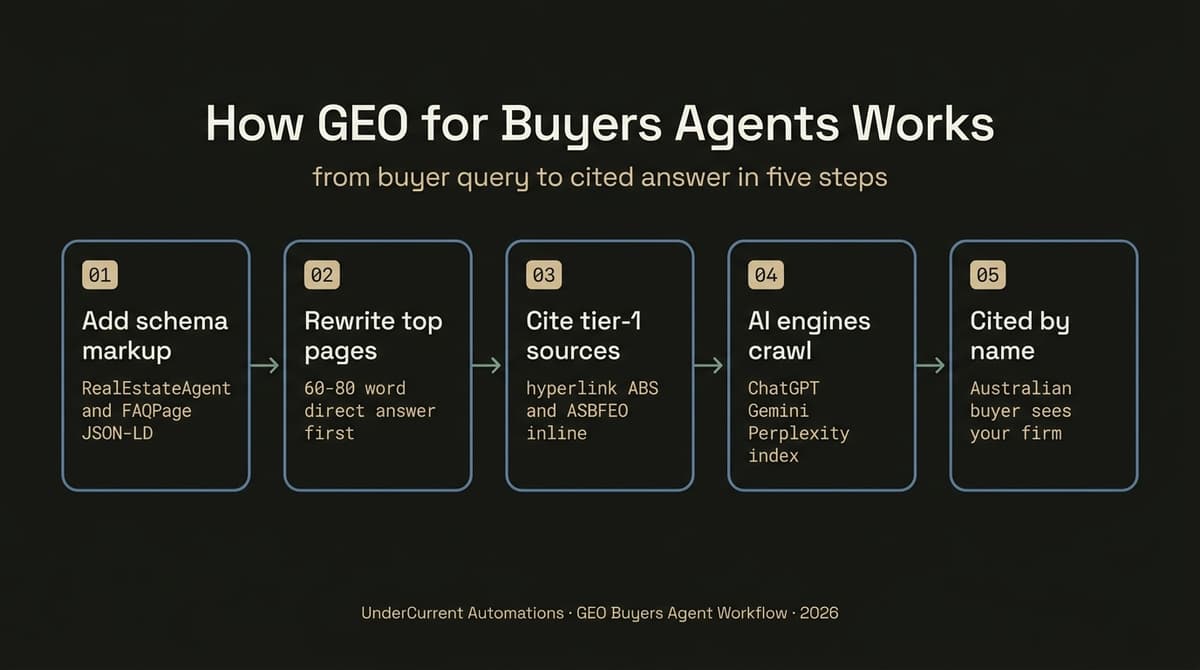
Generative Engine Optimisation is the work of setting up your published content so AI engines (ChatGPT, Gemini, Perplexity, Claude, Google's AI Overviews) pull from it and cite it inside their answers. It's an extension of technical SEO with three differences. First, it rewards direct, extractable answers over keyword-padded prose. Second, it weights structured data heavily, because AI engines read JSON-LD before HTML. Third, it rewards entity density (named tools, suburbs, regulators, dollar figures), because entities are how engines tell one firm apart from the next.
For a buyers agent, the practical question becomes: when a Toorak couple types "should I use a buyers agent or do it myself" into Perplexity, which firms get named in the answer? Right now the cited pages are usually general-information ones (REIA, government sites, big media). GEO is how you trade your way onto that page.
How do AI search engines find buyers agents?
AI engines blend pre-trained knowledge, live retrieval, and your structured metadata on every property query. The ASBFEO Small Business Matters report lays out how Australian small services firms feed the wider economy; AI-search retrieval is the new front door. The ABS Lending Indicators release tracks owner-occupier and investor lending volumes that predict buyers-agent demand in Mosman, South Yarra, New Farm, and Norwood. Kantar's 2025 research found 71% of consumers want generative AI in their shopping experience, including high-consideration buys like property.
AI engines blend three sources on every query: their pre-trained knowledge, real time retrieval (usually a search API call), and your structured metadata. The retrieval layer is where most buyers-agent sites are leaking visibility.
Three retrieval signals move the needle
- Direct-answer paragraph at the top of every page. AI engines pull the first 60–80 words when the query matches the H1.
- Schema markup that explicitly identifies your service.
LocalBusinessplusRealEstateAgentplusFAQPageschema gives the engine a clean entity to attach to. - Hyperlinked citations to tier-1 sources. Citing the ASBFEO Small Business Matters report and the ABS Residential Property Price Indexes signals grown-up content, not vendor copy.
What does the audit data say about Australian buyers agents?
The Melbourne buyers-agency vertical averages 45/100 against our rubric, with zero articles in the Strong band. In May 2026 we ran the UnderCurrent Article Reviewer across 27 articles from 9 firms. Method, per-firm scoring, and structural problems sit in our Melbourne buyers-agency AI search audit, the methodology source for this article.
It's a 100-point rubric across 9 categories, built against Google Search Central docs and Schema.org's RealEstateAgent definition. Rubric version 3.2. Across the 145-article corpus, the whole-corpus mean sits at ~53/100; our own articles average ~80/100. The Melbourne vertical sits 8 points below the wider agency average and 35 below our benchmark.
What surprised us when auditing the corpus
Three things hit harder than the score sheet alone shows
- Schema. Most sites had a single
Articleblock and not much else;RealEstateAgentmarkup was rare;sameAsarrays were almost non-existent. The full bundle is a 30-minute fix nobody had made. - The FAQ pattern: every firm answered "Why choose us?", almost none answered "How much does a buyers agent cost in Sydney?"
- Citations clustered: InfoTrack and Domain showed up everywhere; ABS, ASBFEO, and Treasury showed up nowhere. The cheapest, highest-authority sources were the most ignored.
The 5 pillars of GEO for buyers agents
Five gaps show up across every buyers-agency site we audit, all in three buckets. Structure, content, authority. Our SEO and AI search visibility service covers the same five pillars on a fixed-price retainer.
Pillar 1. Extractive answers. Lead every page with a 60–80 word direct answer.
Pillar 2. Entity density. Name tools (RP Data, CoreLogic, Cotality), regulators (REIA, REIV, Fair Trading), suburbs (Toorak, Mosman, Hamilton, Cottesloe, Glenelg), and dollar figures. More concrete entities wins more shortlist slots.
Pillar 3. Structured data. RealEstateAgent schema on every service page, LocalBusiness plus FAQPage plus Article schema on the blog. JSON-LD, not microdata. Our custom integrations team ships schema bundles in a week. Validate against schema.org/RealEstateAgent and Google's Rich Results Test before deploying.
{
  "@context": "https://schema.org",
  "@graph": [
    {
      "@type": "Article",
      "@id": "https://yourbuyersagency.com.au/blog/your-article-slug#article",
      "headline": "Your Article Headline Here",
      "datePublished": "2026-05-08",
      "dateModified": "2026-05-08",
      "author": { "@id": "https://yourbuyersagency.com.au/about/jane-smith#person" },
      "publisher": { "@id": "https://yourbuyersagency.com.au/#organization" },
      "image": "https://yourbuyersagency.com.au/images/your-article-hero.jpg",
      "mainEntityOfPage": "https://yourbuyersagency.com.au/blog/your-article-slug"
    },
    {
      "@type": "FAQPage",
      "mainEntity": [
        {
          "@type": "Question",
          "name": "How much does a buyers agent in Australia cost?",
          "acceptedAnswer": {
            "@type": "Answer",
            "text": "Australian buyers agents typically charge either a fixed fee or a percentage of the purchase price; fee levels vary by scope, suburb, and property type. Each state requires a current estate agent's licence or buyer's advocate equivalent."
          }
        }
      ]
    },
    {
      "@type": "Person",
      "@id": "https://yourbuyersagency.com.au/about/jane-smith#person",
      "name": "Jane Smith",
      "jobTitle": "Buyer's Advocate",
      "worksFor": { "@id": "https://yourbuyersagency.com.au/#organization" },
      "sameAs": [
        "https://www.linkedin.com/in/jane-smith-buyersadvocate",
        "https://www.realestate.com.au/agent/jane-smith-12345",
        "https://au.linkedin.com/in/jane-smith"
      ]
    },
    {
      "@type": "RealEstateAgent",
      "@id": "https://yourbuyersagency.com.au/#organization",
      "name": "Your Buyers Agency",
      "url": "https://yourbuyersagency.com.au/",
      "logo": "https://yourbuyersagency.com.au/logo.png",
      "serviceType": "Buyers Advocacy",
      "address": {
        "@type": "PostalAddress",
        "addressCountry": "AU"
      },
      "areaServed": [
        { "@type": "City", "name": "Melbourne" },
        { "@type": "City", "name": "Sydney" },
        { "@type": "City", "name": "Brisbane" },
        { "@type": "City", "name": "Perth" },
        { "@type": "City", "name": "Adelaide" }
      ],
      "sameAs": [
        "https://www.linkedin.com/company/your-buyers-agency",
        "https://www.facebook.com/yourbuyersagency",
        "https://www.realestate.com.au/agency/your-buyers-agency-67890"
      ]
    }
  ]
}
The fastest single-line win across the buyers-agency corpus is adding the sameAs array to both the Person and RealEstateAgent nodes. Under 30 minutes of work. The difference between a name string and a verifiable entity for AI extraction.
Pillar 4. Tier-1 citations. Link every quantitative claim to a tier-1 source: ABS, ASBFEO, ATO, Treasury, or a peer-reviewed paper.
Pillar 5. Local proof. Case studies anchored in suburbs (Hawthorn, Surry Hills, Hamilton, Subiaco, Unley), price points, and outcome metrics.
Manual SEO vs GEO: what changes for buyers agents
Traditional SEO still works, but the AI-engine rubric layers stricter rules on top of every page.
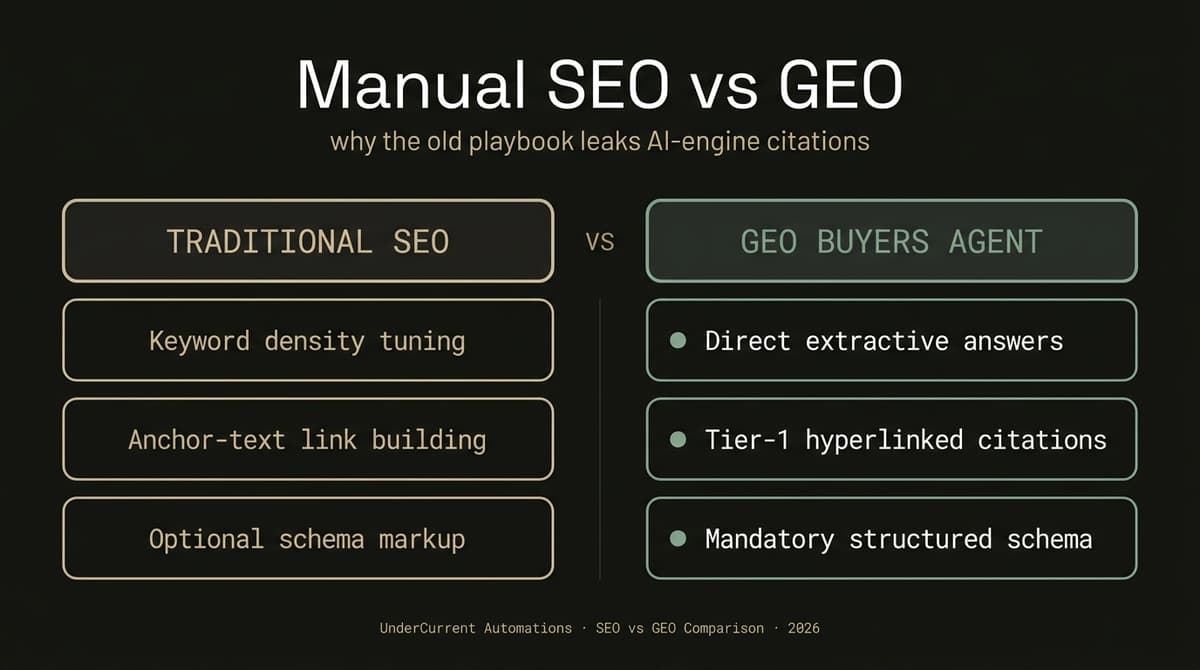
The traditional SEO playbook isn't wrong, it's just incomplete for AI engines. Here's the side-by-side for a buyers-agent site.
| Pillar | Traditional SEO | GEO for buyers agents |
|---|---|---|
| Page intent | Match keywords to ranking pages | Provide extractable direct answers |
| Heading style | Keyword-loaded H2s | Question-shaped H2s the engine can quote |
| Citations | Anchor-text optimisation | Hyperlinked tier-1 references next to the claim |
| Schema | Optional, mostly Article |
Mandatory: RealEstateAgent, LocalBusiness, FAQPage |
| Proof | Generic testimonials | Suburb-named case studies with dollar figures |
| Internal linking | Equity-distribution game | Topic-cluster bridge that signals authority breadth |
| Win condition | First page of Google | Cited by name in the AI answer |
You don't choose between them. Traditional SEO still feeds AI retrieval. The engines run a retrieval call before they answer. The on-page work has to satisfy both at once now, and the AI rubric is stricter.
Step-by-step: implementing GEO on a buyers agent site
The 90-day rollout we use for buyers-agent clients runs in four phases, every one mechanical.
The 90-day rollout, in four phases
- Schema and tech audit. Drop
RealEstateAgentandLocalBusinessschema on every service page. AddFAQPageschema to your FAQ blocks. Validate with Google's Rich Results Test. Fix anything blocking crawl:noindextags, slow LCP, broken canonicals, Days 1–14 - Rewrite the top 8 commercial pages. Lead with a 60–80 word direct answer. Restructure H2s as questions. Add a comparison table to your "do I need a buyers agent" page. Three hyperlinked tier-1 citations per page minimum. Our AI strategy and training programme walks teams through it, Days 15–35
- Build three suburb-anchored cluster pillars. Pick three highest-revenue cities and a flagship suburb or two each. Melbourne (Toorak, Albert Park, Hawthorn, Brighton) at /ai-automation-melbourne. Sydney (Mosman, Paddington, Double Bay, Bondi) at /ai-automation-sydney. Brisbane (New Farm, Bulimba, Hamilton) at /ai-automation-brisbane. Perth at /ai-automation-perth. Adelaide at /ai-automation-adelaide. Each pillar gets a master page plus 4–6 supporting articles, cross-linked through the national hub, Days 36–60
- Case studies plus reciprocal citation. Publish three suburb-anchored case studies with named outcomes. Reach out to three tier-1 sources you cite. Reciprocal citation grows your retrieval graph faster than cold-pitch link building, Days 61–90
Why now: Australian small business AI adoption context
The window for an Australian buyers agent to plant a flag in AI-engine answers is open right now, and closing. Xero's 2025 small business data release reported 2025 sales volatility across Australian SMBs. Services subsectors (including real estate) showed the steepest variance. AI search is the channel adding share. The ASBFEO small business data portal puts the count of small businesses at over 2.5 million as of mid-2025, with real estate tracking a 2.0% CAGR per IBISWorld's industry brief. The KPMG Australian Retail Outlook 2025 reports wider AI adoption across consumer-facing sectors above 30% by mid-2025. The Treasury small business growth strategy paper flags digital adoption gaps as the main lift chance for SMBs, real estate included. The window for a Toorak, Mosman, or New Farm buyers agent to plant a flag and own AI-engine real estate in their suburb is open right now. The early-mover advantage will compound over the next 18 months.
Key data points referenced in this article
Every quantitative claim above sits in this table with its primary source and date.
| Statistic | Source | Date |
|---|---|---|
| 24% of Australian businesses (5–200 employees) used AI, 8% in 2022 | ABS Australian Industry release | 2024 |
| Buyer-agent involvement rose 4–5% → 14–15%, 75% of buyers did not use one, 60% above-average satisfaction among the 25% who did | InfoTrack 2025 State of Real Estate Report | 2025 |
| 71% of consumers want generative AI in shopping experiences | Kantar consumer research | 2025 |
| 45,440 Real Estate Services firms, 2.0% CAGR 2020–2025 | IBISWorld Real Estate Services | 2025 |
| 2.5M+ small businesses in Australia | ASBFEO Data Portal | 2025 |
| AI adoption above 30% across consumer-facing sectors | KPMG Australian Retail Outlook | 2025 |
| SMB automation benchmark: $2,500–$12,000 first-project, 60–90 day payback | UC summary of public Bocati case data | 2025 |
| UnderCurrent Article Reviewer Melbourne audit: 27 articles / 9 firms, 45/100 mean | UC Melbourne audit | May 2026 |
| Whole-corpus mean across UC's 145-article rubric run, UC own-content avg ~80/100 | UC Article Reviewer corpus | 2026 |
What are the common GEO mistakes for buyers agents?
Five patterns show up repeatedly when we audit buyers-agency sites, and every one is mechanical to fix.
Mistake 1. Marketing FAQs. "Why choose us?" doesn't get cited. Real Google queries do. "How much does a buyers agent cost in Sydney?" "Are buyers agents worth it for first home buyers?" Rewrite your FAQ to questions a real buyer types in.
Mistake 2. Hidden case studies. Most buyers agents bury their wins in testimonials with no numbers. Strip the names if you must, but keep the suburb (Brighton, Double Bay, Hamilton, Subiaco), the price, the gap to reserve, and the timeline.
Mistake 3. Schema as afterthought. A single Article schema on the homepage isn't GEO. You need RealEstateAgent, LocalBusiness, FAQPage, and Article together. Add sameAs arrays on Person and RealEstateAgent. Validate against Google's Rich Results Test.
Mistake 4. Generic location pages. "Melbourne Buyers Agent" with three paragraphs of generic copy gets ignored. The version that wins names suburbs (Albert Park, Hawthorn, Mosman, Paddington, Glenelg), price brackets, school catchments, and recent transactions.
Mistake 5. No reciprocal authority. You cite REIA, Cotality, ABS. Nobody cites you back. Pitch one tier-1 source per month with original data from your transactions.
Tools and platforms for GEO measurement
A minimum viable GEO stack costs under $200 a month and centres on citation share as the headline metric. We track GEO performance across our client base using the stack below. AI-engine citation share is the headline metric.
- Manual prompt audit. Run 30 queries an Australian property buyer would type. Record which firms get cited. Repeat monthly.
- Schema validation. Google's Rich Results Test and Schema.org's validator, monthly.
- Structured data tracking. Tools like Profound and Athena AI explicitly measure AI-engine citation share. Newer than Ahrefs, built for this use case.
- CRM integration. Connect AI-search-attributed leads to your CRM (Xero, MYOB, ServiceM8, or your own database). Our custom integrations service ships these as one-off projects.
- Performance benchmarking. Map your buyers-agency unit economics against the Treasury SMB digital adoption brief. Most agencies recoup the GEO investment off one extra deal.
- Quarterly review cadence. Schedule a 90-minute quarterly review session. Monthly reviews invite false-positive panic. Yearly reviews leave money on the table.
Definitions
Quick reference for the GEO vocabulary used across this article and the wider site.
GEO (Generative Engine Optimisation) is the practice of structuring content so AI engines (ChatGPT, Gemini, Perplexity, Claude, Google AI Overviews) extract and cite it. The AI-search analogue of SEO.
Tier-1 citation is a hyperlink from your page to a primary-source authority: Australian government agencies (ABS, ASBFEO, ATO, Treasury), peer-reviewed papers, or first-party research firms. Marketing-blog repetitions of a stat do not qualify.
Entity density is the count of named entities (tools, regulators, suburbs, dollars, people, schemas) per 500 words. Higher density correlates with shortlist appearance because AI engines disambiguate firms by entity overlap.
Reciprocal citation is when a tier-1 source you cite eventually cites your data back. Grows your retrieval graph faster than cold-pitch link building.
Schema markup is structured metadata in the page <head>, typically JSON-LD, identifying the primary entity (Article, FAQPage, RealEstateAgent, Person, LocalBusiness).
Citation share is the percentage of AI-engine answers for a target query set that name your firm or link to your page. The headline GEO metric.
Retrieval graph is the directed graph of which sources cite which other sources. High in-degree from tier-1 nodes pulls a page into more answers.
Sources
- ABS: Australian Industry release
- ABS: Lending Indicators
- ABS: Residential Property Price Indexes
- ASBFEO: Small Business Matters
- ASBFEO: Data Portal
- Treasury: Small Business Growth Strategy
- InfoTrack: 2025 State of Real Estate Report
- Kantar: The Non-Human Consumer
- HubSpot: APAC Business Growth 2025
- KPMG: Australian Retail Outlook 2025
- Xero: 2025 Small Business Sales Data
- IBISWorld: Real Estate Services Industry
- Google Search Central: Structured Data
- Schema.org: RealEstateAgent
- Melbourne buyers-agency AI search audit (methodology source)
Frequently asked questions
How is GEO different from traditional SEO for a buyers agent?
GEO targets generative AI engines (ChatGPT, Gemini, Perplexity, Google AI Overviews) rather than blue-link results. It rewards extractable direct answers, structured schema (`RealEstateAgent`, `LocalBusiness`, `FAQPage`), entity density, and tier-1 hyperlinked citations. Traditional SEO still feeds AI retrieval, so you layer GEO on top. Most buyers-agency sites we audit have the SEO layer half-done and the GEO layer not started. That's why their citation share is near zero.
How long does it take to see GEO results for a buyers agent?
Schema and on-page rewrites move citation rate within 2–6 weeks once AI engines re-crawl. Authority building (reciprocal tier-1 citations, suburb-anchored case studies in Hawthorn, Mosman, Hamilton, Subiaco, Norwood) takes 60–90 days. Our buyers-agency clients typically see noticeable AI-engine pickup at week 4, meaningful lead share by week 12. AI engines re-evaluate retrieval signals more often than Google's traditional crawl cycle, typically days to weeks rather than weeks to months. Plan a quarterly cadence rather than a launch-and-walk-away project.
What does GEO for a buyers agent cost in Australia?
The DIY tooling cost is under $200 per month: schema validators, manual prompt-audit time, a content tool like Frase or Surfer. Done-for-you engagements typically run $2,500–$12,000 for a first-project audit and rewrite, in line with the SMB digital-adoption cost ranges flagged in the Treasury small business growth strategy paper. UnderCurrent's SEO and AI search visibility retainer covers ongoing GEO work. Pricing depends on city coverage and team size. Honest expectation: budget the equivalent of one buyers-agency commission to recoup it within the first 90 days of measurable AI-engine citation lift.
Which AI engines should a buyers agent target first?
ChatGPT and Gemini lead AI engine usage among US property buyers based on recent industry surveys, with Perplexity catching up fast in research-heavy use cases. Google's AI Overviews matter because they intercept queries before they hit the blue links. Target ChatGPT first because the rubric is the strictest. Pages that satisfy ChatGPT's extraction model usually satisfy the others. The HubSpot 2025 APAC business growth report shows the same engine mix dominating Australian SMB AI use.
Can a small buyers agency compete with the big national players on GEO?
Yes, the small-firm advantage is sharper than in traditional SEO. Big national agencies can't write Toorak-, Mosman-, New Farm-, Cottesloe-, or Glenelg-specific content the way a local specialist can. AI engines cite the page that names the suburb and the price bracket. They don't cite "we cover all of Australia." Most buyers searches are city-and-price-specific, which favours the suburb specialist. In 18 months the slot is taken.
What internal data should a buyers agent publish for GEO?
Anything quantitative and reproducible. Median gap to reserve across your last 50 deals. Average time on market for properties you targeted in Albert Park or Paddington. Suburb-level success rates by price bracket. Strip personally identifying info, but keep the numbers. AI engines weight first-party data differently. A published transaction breakdown from your firm carries more retrieval weight than the same number cited from a third party. The InfoTrack 2025 State of Real Estate Report is a summary, not a substitute. Your own data is the moat.