

How to Use an AI Agent for Business in Australia
Quick answer
An AI agent for business in Australia is software that does multi-step tasks for you, like booking jobs, chasing invoices and qualifying leads, without a click each time.
- About 40% of Australian SMEs used some form of AI agent by late 2024
- SMEs using AI grow 2.8 times faster than those that don't
- Start with one process

| Strategy / Use Case | Estimated Time Saved | Typical Monthly Cost (AUD) | Best For |
|---|---|---|---|
| Lead follow-up agent | 4–8 hrs/week | $100–$400 | Tradies, agencies |
| Invoice & payment chasing | 3–6 hrs/week | $80–$250 | Any service business |
| Appointment booking agent | 2–5 hrs/week | $50–$200 | Clinics, consultants |
| Customer service / FAQ agent | 5–10 hrs/week | $100–$350 | Retail, hospitality, agencies |
| Job scheduling and dispatch | 3–7 hrs/week | $150–$500 | Trades, field services |
| Reporting and data summaries | 2–4 hrs/week | $100–$300 | Agencies, professional services |
What Is an AI Agent for Business?
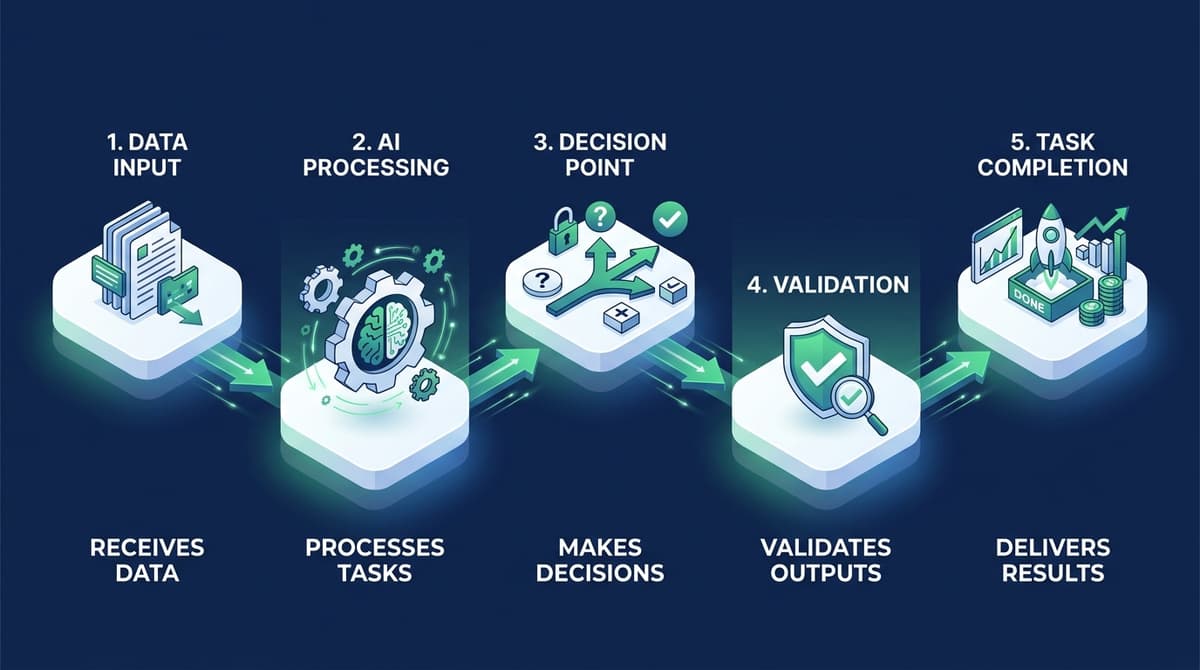
An AI agent is autonomous software that perceives its environment, makes decisions, and takes actions without a human triggering each step. Unlike a standard automation that follows a fixed script, an AI agent can handle unexpected inputs, choose between options, and complete multi-step workflows from start to finish. For the short, one-screen definition with the workflow-vs-agent distinction, see our AI agent glossary entry.
The clearest way to understand it: a basic automation is a domino chain, knock the first one, the rest fall in order. An AI agent is more like a junior employee, you give it a goal, and it figures out the steps.
AI agent is defined as: software that observes data, reasons over it, and executes actions within set boundaries to complete a defined goal.
Business process automation is defined as: using software to handle repetitive, rule-based tasks that previously required manual human effort.
Agentic AI is defined as: AI systems capable of independent decision-making across multiple steps, as opposed to single-turn chatbots or static rule-based tools.
According to the Australian Bureau of Statistics, AI is now the fastest-growing area of business R&D in Australia, with expenditure reaching $668.3 million in 2023–24, a 142% increase from $276.3 million in 2021–22. That's total business R&D of $24.4 billion, up 18% in two years. It's not a niche experiment anymore.
Where this matters for a small business: AI agents connect to the tools you already use, Xero, MYOB, HubSpot, ServiceM8, Tradify, your CRM, and act on data inside them. They don't just flag a task. They complete it. For a deeper look at how these systems fit together, the UC automation services page breaks down the main categories we build for Australian businesses.
How Do AI Agents Differ From Chatbots and Basic Automation?
AI agents sit a step above chatbots and standard automation tools, and the difference matters when you're deciding what to buy.
A chatbot responds to a single question. A standard automation runs a fixed sequence. An AI agent does both, then makes a judgement call based on context and takes action across multiple systems.
| Feature | Chatbot | Standard Automation (Zapier / Make) | AI Agent |
|---|---|---|---|
| Handles multi-step tasks | No | Partially | Yes |
| Makes decisions mid-task | No | No | Yes |
| Learns from past interactions | No | No | Yes (with memory) |
| Integrates across multiple tools | No | Yes | Yes |
| Takes actions (books, sends, updates) | No | Yes | Yes |
| Handles exceptions / edge cases | No | No | Yes |
| Requires constant human triggers | Yes | Partially | No |
| Setup complexity | Low | Medium | Medium–High |
A chatbot on your website can answer "what are your hours?" An AI agent can take an enquiry, check your calendar, confirm a booking slot, send the client a confirmation SMS, create the job in ServiceM8, and flag it in Xero, all while you're on a roof or in a meeting.
Gartner predicts that 40% of enterprise applications will feature task-specific AI agents by 2026, up from less than 5% in 2025. That shift is already happening in the businesses around you.
If you want to understand where AI agents fit in a broader automation strategy, the how we work page explains the sequencing we use with every new client.
What Can an AI Agent Actually Do for an Australian Small Business?
AI agents handle the tasks that eat your time but don't need your brain. For most Australian service businesses, that's lead follow-up, invoicing, scheduling, and customer communication.
Here are the real-world applications that move the needle fastest:
Can an AI Agent Handle Lead Follow-Up Automatically?
Yes, and this is where most service businesses see the fastest return. An AI agent monitors your inbound enquiry channels (website form, email, missed calls), sends a personalised response within minutes, qualifies the lead with a couple of questions, and books them into your calendar. No manual chasing.
According to Xero's Small Business Insights, cash flow and time pressure are the two most cited constraints for Australian small businesses, and slow lead response directly compounds both by losing jobs before they're even quoted. Across our automation audits, the most consistent finding is a response gap between when a lead arrives and when someone actually follows up, often 4–24 hours, by which point the prospect has called someone else. That single bottleneck costs more than most business owners realise. The inbound lead management service page explains how we close that gap.
Can an AI Agent Chase Invoices and Handle Payments?
Absolutely. An invoice-chasing agent connects to Xero or MYOB, monitors overdue balances, sends personalised payment reminders at set intervals (7 days, 14 days, 30 days), escalates the tone appropriately, and flags persistently overdue accounts for your attention. You review the exceptions. The agent handles the volume.
MYOB's Business Monitor consistently shows late payments as a top-five issue for Australian SMEs, with trade businesses among the hardest hit, many carrying 30–60 days of outstanding invoices at any point. Based on typical outcomes from our automation audits, a trade business in Joondalup with six staff was spending roughly five hours a week manually following up on overdue invoices. After connecting an AI agent to their Xero account with a tiered reminder sequence, that dropped to under an hour, a 15-minute review of flagged accounts instead of a Friday afternoon of phone calls. You can run your own numbers using the UnderCurrent automation audit.
What About Scheduling, Dispatch, and Job Management?
For trade and field service businesses, scheduling is one of the biggest time sinks. An AI agent can handle new booking requests, check existing job schedules, assign the right team member based on location and availability, send confirmation to the client, and update the job board in tools like Tradify or ServiceM8.
According to the ABS Business Characteristics Survey, businesses with 5–19 employees account for a significant share of total small business employment in Australia, and this cohort consistently reports scheduling and coordination as a primary operational constraint. Job scheduling is one of the top use cases where AI agents reduce manual effort in this size bracket. For examples of how this plays out in practice, the case studies page has real-world builds across trades and field services.
How Do AI Agents Handle Customer Service and FAQs?
An AI agent deployed on your website or via SMS can handle the top 20 questions your business gets asked every week, pricing, availability, service areas, booking process, and escalate the unusual ones to a human. This isn't a static FAQ page. The agent reads the question, decides on the best answer based on your business rules, and responds conversationally.
Deloitte's Digital Consumer Trends report for Australia found that 61% of Australian consumers expect a response to a service enquiry within the same day, and 29% expect a response within an hour. For service businesses with high enquiry volume, a customer service agent that responds instantly, even at 11pm on a Sunday, pays for itself in the first month. The customer experience automation service covers exactly this use case.
If you want this scoped for your business, book a scoping call, we'll map the highest-value agent build for your existing tools.
How Much Does an AI Agent Cost for an Australian Business?
AI agents for small businesses in Australia typically run $50–$400 per month for off-the-shelf platforms, based on published pricing from tools like Make, n8n, and vertical-specific tools, with custom-built systems typically costing $2,000–$10,000 upfront depending on complexity. Government incentives can cut those upfront costs significantly.
What Do Off-the-Shelf AI Agent Tools Cost?
Platforms like Make, n8n, or vertical-specific tools publish tiered pricing from free through to enterprise. Most small businesses land in the $50–$400 per month range depending on volume and the number of connected tools. For a tradie or small agency, a well-configured tool at $150/month that saves 10 hours a week is paying for itself inside a fortnight.
MYOB's Business Monitor found that SMEs using automation grow significantly faster than those that don't, and every quarter without it is a quarter competitors are widening the gap. For a breakdown of which automation category fits your situation, the automation services page lists them by business type. If you're unsure where to start, a free automation audit takes about 30 minutes and maps the highest-value opportunity first.
Are There Government Incentives Available?
Yes, and they're worth knowing about. The Australian Government's AI Adopt Program offers matched co-funding for eligible small businesses investing in AI adoption, part of a broader commitment to supporting SME technology uptake. Separately, the ATO's R&D Tax Incentive provides a 43.5% refundable offset for companies with turnover under $20 million, and AI systems that automate business processes can qualify where they involve genuine experimentation or technical uncertainty.
For a business considering a custom AI agent build, a $50,000 investment has a net cost of roughly $28,250 after the ATO offset. These incentives make a high-quality system genuinely accessible without betting the house.
What's the ROI Timeframe?
McKinsey's analysis of automation ROI estimates that AI and automation deployments in service businesses typically reach payback within 6–18 months, with faster returns for high-volume, repetitive workflows. For Australian SMEs in trades and professional services, where admin load is high and margins are squeezed, that window is often 2–4 months when the agent targets lead response or invoice chasing specifically.
A Footscray wholesale distributor with 12 staff reduced inventory holding by 18%, freed $125,000 in cash, and cut receipt processing from four hours to 45 minutes per week, with an annual tool cost of $7,044 and a net benefit of $136,320. If you want to run your own numbers before committing, the UnderCurrent automation audit gives you a rough figure based on your current hours and hourly rate. More detailed build outcomes are documented in the case studies section.
How Do You Actually Get Started With an AI Agent?
Getting started with an AI agent doesn't require a developer or a six-month project. Most service businesses can have something running in two to four weeks.
Here's the practical path
- Pick one problem. Don't try to automate everything. Pick the task costing you the most time or the most money. Slow lead response and manual invoice chasing are the two most common starting points for Australian service businesses.
- Map the current process. Write out exactly what happens today, who does what, in which tool, in what order. If you can't describe the process, you can't automate it.
- Choose your toolset. For most small businesses, off-the-shelf platforms (Make, n8n, or vertical tools like ServiceM8's automation features) handle 80% of use cases. For more complex or custom workflows, a purpose-built agent is worth considering. The AI automation Melbourne page covers the options we typically recommend for Victorian businesses.
- Connect your existing tools. An AI agent is only as useful as the data it can access. Connect it to your CRM, your accounting software, your calendar. Most major tools have native integrations or APIs.
- Test with low stakes. Run the agent in parallel with your existing process for one to two weeks. Compare outputs. Fix gaps before you turn off the manual process.
- Review and adjust monthly. AI agents improve with feedback. Set a monthly review to check where the agent is making errors, missing context, or triggering false positives.
For a broader view of which processes to automate first, the UC guide to automating business processes in Australia is a solid starting point. The finance automation and sales automation pages are worth reviewing too if invoicing or lead follow-up is your main bottleneck.
In UC's own client onboarding workflow, the businesses that get the fastest results are the ones that start with a single, clearly defined process, not a sprawling wishlist. One well-built agent beats six half-finished ones every time.
If you'd rather have this built for you, book a scoping call, most builds go live in under two weeks.

Sources
- Australian Bureau of Statistics, AI Now Fastest Growing Area of Business R&D
- ABS Business Characteristics Survey
- ATO, R&D Tax Incentive
- Australian Government, AI Adopt Program
- MYOB Business Monitor
- Xero Small Business Insights
- Gartner, Enterprise Apps with Task-Specific AI Agents Forecast
- Deloitte, Digital Consumer Trends Australia
- McKinsey, The Economic Potential of Generative AI
- Make, Pricing
- n8n, Pricing
- Thomas Wiegold, AI Agents for Small Businesses Sydney
- Inside Small Business, SMEs Adopting AI Grow 2.8 Times Faster
- OAIC, Privacy Act 1988
Frequently asked questions
How long does it take to set up an AI agent for a small business in Australia?
Setting up an AI agent for a small Australian business typically takes two to four weeks from first conversation to live deployment. Off-the-shelf platforms like Make or n8n can be configured faster, sometimes within days for simple workflows. Custom builds integrating multiple tools such as Xero, ServiceM8, and a CRM sit at the longer end of that range. Most businesses have their first agent running within a month of making the decision to start.
Is my business data safe when using an AI agent platform in Australia?
Data safety is a genuine concern for Australian businesses covered by the Privacy Act 1988. Reputable AI agent platforms offer Australian data residency options, audit logs, and role-based access controls. When evaluating any tool, ask whether your data is stored in Australian AWS or Azure regions and whether the vendor complies with Australian Privacy Principles. Businesses in regulated industries, healthcare, finance, or legal, should get compliance advice before deploying any agent that touches client data.
Do I need a developer to build and run an AI agent for my business?
You don't necessarily need a developer to get started with an AI agent. Platforms like Make and n8n are built for non-technical users, with drag-and-drop interfaces and pre-built connectors to tools like Xero, MYOB, HubSpot, and ServiceM8. For more complex builds, multi-step logic, custom APIs, or data compliance requirements, most small businesses work with an automation specialist. See how we work for a practical overview of what a typical build looks like end to end.
What's the difference between an AI agent and standard business process automation?
Business process automation is the broader category, using software to handle repetitive, rule-based tasks. An AI agent is a more advanced form that adds genuine decision-making capability. Standard automation follows a fixed script: if an invoice is unpaid at 7 days, send an email. An AI agent reads context, adjusts its approach, and handles exceptions, for example, recognising a client has already responded and holding the next reminder. Basic automation is the right starting point; AI agents are the logical next step. For more background, see the business process automation explainer.
Can an AI agent integrate with tools I'm already using like Xero or ServiceM8?
Yes, most AI agent platforms connect natively to the tools Australian service businesses already use. Xero, MYOB, HubSpot, ServiceM8, Tradify, and Google Calendar all have published APIs or pre-built integrations with platforms like Make and n8n. The agent reads data from these tools and writes back to them, updating job records, sending invoices, logging calls. Setup typically requires connecting accounts through an API key or OAuth, not custom development.
How do I know which process to automate first with an AI agent?
The best first process to automate is the one that's highest volume, follows a consistent repeatable pattern, and is easy to measure before and after. For most Australian service businesses, that's either lead follow-up or invoice chasing, both are well-defined, happen frequently, and produce visible results within weeks. MYOB's Business Monitor consistently identifies admin overload as a top-three constraint for SMEs. A free automation audit will identify the highest-value starting point for your specific situation.
Who can build an AI agent for my small business in Australia?
UnderCurrent Automations builds done-for-you AI agent systems for Australian service businesses, covering lead follow-up, invoice chasing, job scheduling, and customer service automations, all connected to your existing tools including Xero, HubSpot, and ServiceM8. Most builds go live in under two weeks. If you're not sure where to start, book a scoping call and we'll map exactly which process will return the most time and money first.