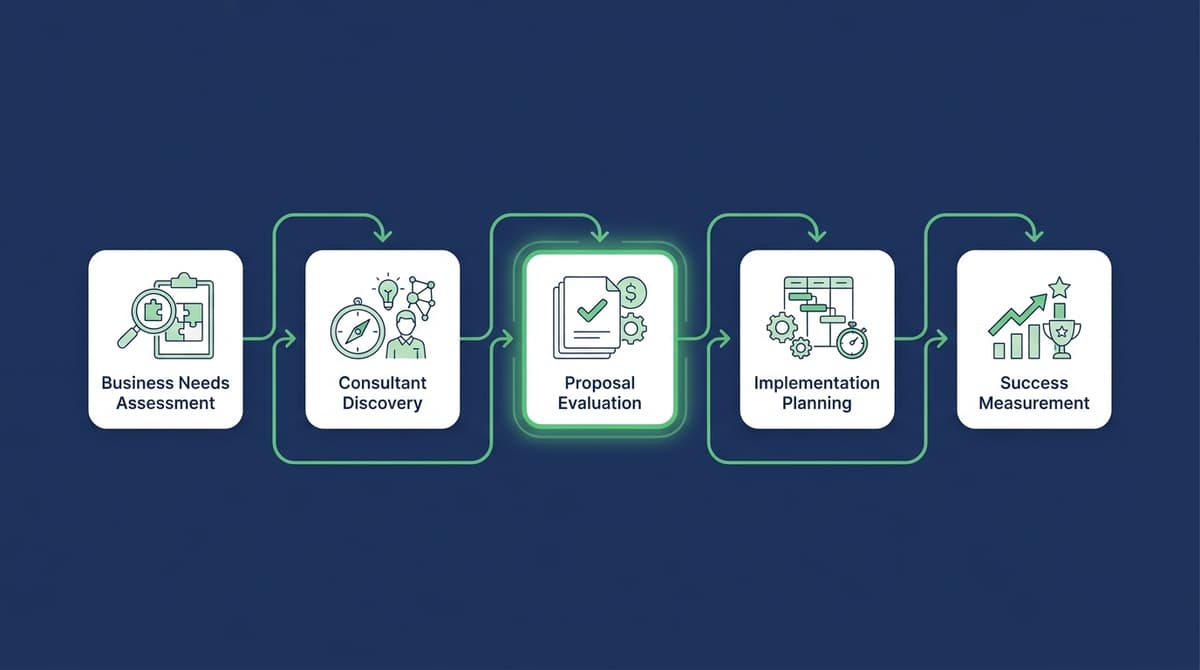
Quick Project Overview
| Service Type | Typical Cost (AUD) | Timeline | Outcome |
|---|---|---|---|
| Automation audit | $800-1,500 | 1-2 weeks | Prioritised workflow map |
| Single-system automation (e.g. invoicing) | $2,000-4,000 | 2-4 weeks | 10-20 hours saved/month |
| Multi-system integration (CRM + accounting + scheduling) | $5,000-10,000 | 4-8 weeks | 40-60 hours saved/month |
| Custom AI agent or chatbot | $8,000-15,000 | 8-12 weeks | Variable based on scope |
| Ongoing support/maintenance | $500-1,500/month | Continuous | System monitoring, adjustments |
Workflow automation is a system where software completes recurring tasks without manual input. AI automation consultants in Melbourne build workflow systems that connect your existing tools, CRM, accounting software, booking calendars, email, so repetitive tasks happen automatically. They're not selling you AI hype, they're wiring up your business so you spend less time on data entry and follow-up. According to a McKinsey report on AI adoption, 65% of organisations now use AI regularly, but only 6% are "fully enabled" with strategic implementation. Most businesses sit somewhere in the middle, running basic automation through embedded features in platforms like Xero or HubSpot but needing help with custom workflows that connect multiple systems.
The gap between using AI occasionally and embedding it strategically is where consultants operate. A Deloitte study on Australian business automation found that Melbourne small businesses typically save 10-20 hours per week by day 90 of implementation, with measurable revenue impact from faster lead response, fewer missed invoices, and reduced admin overhead.
From building UC's own content pipeline that publishes multiple articles per week across clusters, the first bottleneck in any content system is always the same: manual handoffs between stages. That's the pattern consultants look for across every business function, where data moves manually between tools, where someone has to remember to follow up, where a task sits waiting because it depends on someone else finishing something first. If you're unsure where the leaks are in your workflows, start with a free automation audit to map exactly what's breaking.
What Does an AI Automation Consultant Actually Do?
An AI automation consultant maps your workflows, finds the repetitive tasks burning time, and builds systems to handle them without human input. The work splits into three phases: audit (what's broken), build (fix it), and maintain (keep it running). Most Melbourne consultants start with an audit, 1-2 weeks of watching how your business actually operates, not how you think it operates. They're looking for the gaps: leads that don't get followed up, invoices sent late, quotes sitting in draft, customer data living in three different spreadsheets.
The build phase is where the automation happens. Consultants connect your tools using platforms like Make, Zapier, or n8n, or write custom code if your systems don't talk to each other natively. A typical example: when a new lead comes in through your website form, the system automatically creates a contact in your CRM, sends a templated follow-up email within 2 minutes, books a tentative call slot, and notifies you via SMS. No manual data entry, no waiting until you're back at your desk. At UnderCurrent Automations, we build these exact workflows for Australian service businesses every week.
Google's research on business automation shows that businesses reaching intermediate AI maturity see a 45% profitability increase, while fully enabled businesses achieve 111%. The difference isn't the tools, it's the integration depth. A consultant's job is to move you from "we use Xero for invoicing" to "our invoicing happens automatically when the job is marked complete in ServiceM8, and overdue reminders go out at 7, 14, and 30 days without anyone touching it."
We typically see automation systems need 2-3 tweaks in the first 90 days as edge cases surface. That's where post-launch support matters. Understanding how we work helps you set realistic expectations for the build-test-refine cycle.
What's the Difference Between an AI Consultant and a Regular Automation Consultant?
An AI consultant focuses on decision-making automation, chatbots, predictive tools, content generation, while a workflow automation consultant focuses on connecting existing systems. AI-specific automation refers to systems that use machine learning or large language models to make decisions, not just move data. Most small businesses don't need AI-specific consulting yet, they need workflow automation. The chatbot that answers customer questions 24/7 sounds great until you realise your real problem is that nobody follows up on the questions the chatbot collects.
The line blurs when consultants use AI features embedded in automation platforms. Make and Zapier now include GPT-powered text generation, sentiment analysis, and data extraction. A consultant might use AI to draft email responses based on customer enquiry type, or to categorise leads by urgency, but the core work is still wiring systems together.
An Australian Bureau of Statistics report on business technology adoption found that 58% of Australian SMEs have adopted digital tools, but most are using embedded features in existing software, Xero's invoice matching, HubSpot's email subject line tuning, ServiceM8's job scheduling suggestions. Hiring a consultant for "AI strategy" when what you actually need is "connect my CRM to my email tool" wastes money.
If your processes are manual and repetitive, start with workflow automation services. If your processes are already automated and you want predictive analytics or custom AI agents, then look for AI-specific expertise. For Melbourne businesses specifically, AI automation Melbourne covers the local service options.
How Much Does an AI Automation Consultant Cost in Melbourne?
Melbourne automation consultants typically charge $150-250/hour for hourly work, or $3,000-8,000 for fixed-scope projects covering single-workflow builds. Larger integrations connecting 3+ systems run $10,000-20,000. The pricing depends on complexity, not hours, a consultant quoting you $15,000 for a multi-system CRM integration isn't overcharging if the work saves your team 60 hours a month.
Australian SMBs achieve 3-4x ROI in the first month from automation costing $500/month, saving 50-80 hours at $45/hour labour rates for a net $1,750/month gain. A Melbourne plumbing firm saved 45 hours monthly and recovered $12,000 in previously lost quotes for a $350/month automation cost. A Brisbane clinic reduced no-shows by 40%, saving $4,200/month at a $280/month system cost.
The ROI calculation is straightforward: how many hours does this task take per month, what's the hourly cost (your wage or staff wage), how much does the automation cost. If you're spending 20 hours a month on manual invoicing at $50/hour, that's $1,000 of labour. An automation system costing $3,000 upfront and $200/month pays for itself in 3 months, then saves you $800/month after that. Use the automation audit to run your own numbers before committing to any project.
Ongoing maintenance typically runs $500-1,500/month depending on system complexity. Some consultants bundle maintenance into the initial build cost for the first 6 months. Others charge separately. Ask upfront.
A clear project scope should include: what gets built, what tools it connects, how long it takes, what success looks like, and who owns the automation once it's live. If a consultant can't give you that breakdown, they're not ready to build.
What Should I Ask a Consultant Before Hiring Them?
Ask for examples of similar projects they've completed, how they price (hourly vs. fixed), who owns the automation once built, and what post-launch support includes. The conversation should feel like a diagnosis, not a sales pitch. A good consultant asks more questions than they answer in the first call.
Key questions to ask:
"Can you show me 2-3 examples of automation you've built for businesses similar to mine?" You're checking for relevant experience. A consultant who's built 20 e-commerce automations but never worked with trade businesses won't understand your workflows. Look for industry match or at least transferable patterns, appointment scheduling, invoicing, follow-up. Check case studies from multiple consultants before deciding.
"How do you price this work, hourly or fixed project?" Fixed-price projects are safer for you if the scope is clear. Hourly is riskier because costs can blow out. If they quote hourly, ask for a cap. If they quote fixed, ask what happens if scope changes mid-project.
"Who owns the automation after you build it, and what access do I have?" You should own the workflows. The consultant should build everything inside your accounts, your Make workspace, your Zapier account, not theirs. If they insist on building in their environment, you'll be stuck paying them forever to make changes.
"What's included in post-launch support?" Expect 30-90 days of included bug fixes and minor tweaks. After that, ongoing support should be optional, not mandatory. If the automation breaks because a tool updates its API, who fixes it and at what cost?
"How long will this take, and what's the timeline?" Single workflows: 2-4 weeks. Multi-system builds: 4-8 weeks. Custom AI work: 8-12 weeks. If a consultant quotes 6 months for a lead follow-up automation, they're either overcomplicating it or have a backlog.
Red flags: can't show relevant portfolio work, vague answers about ownership or support, pushes expensive tools you don't need, won't give a timeline or cost estimate after understanding your needs, uses jargon instead of explaining clearly.
If the consultant spends the first call telling you about their platform's proprietary machine learning instead of asking what's breaking in your business, walk away. The best consultants listen first, diagnose second, quote third.
What Should I Automate First in My Business?
Start with lead follow-up if you're losing enquiries to slow response times, or invoicing if you're chasing late payments. The first automation should tackle the highest-pain, highest-frequency task. If you're spending 10 hours a week on manual invoicing and 2 hours a week on follow-up, fix invoicing first even though follow-up feels more urgent.
Priority order for most Australian small businesses:
1. Lead follow-up and enquiry management Automate instant responses to web form submissions, email enquiries, and Facebook messages. A Sydney digital agency we worked with was losing 30% of inbound leads because nobody followed up within 24 hours. After automating instant email and SMS responses with a 3-day drip sequence, lead conversion went from 18% to 31% in two months. Our inbound lead management service handles exactly this workflow.
2. Invoicing and payment reminders Connect your field service software or project management tool to Xero or MYOB. When a job is marked complete, an invoice generates and sends automatically. Payment reminders go out at 7, 14, and 30 days overdue without manual intervention. Finance automation is the fastest ROI generator for most service businesses.
3. Client reporting and data aggregation If you're spending 4-6 hours a month compiling reports from Google Analytics, Facebook Ads, and your CRM, automate it. Pull the data into a dashboard, generate a PDF, email it to the client on the 1st of each month. From building UC's own content pipeline that publishes multiple articles per week across clusters, the second we automated our performance reporting, we freed 8 hours monthly that went back into production work.
4. Appointment scheduling and reminders Connect your booking calendar to your CRM and email tool. When someone books, send a confirmation email immediately, then reminders at 24 hours and 2 hours before the appointment. A Melbourne physio clinic we assessed was averaging 4 no-shows per week at $95 per session. Automated SMS reminders brought no-shows down to 1 per week, recovering $1,140 monthly.
Start with one workflow, test it for 30 days, then move to the next. Trying to automate everything at once overwhelms your team and makes it harder to measure ROI per workflow. If you're unsure which process to tackle first, book a free automation audit to get a prioritised list based on your actual workflows.
Where Do I Find AI Automation Consultants in Melbourne?
Search "AI automation consultant Melbourne" or "workflow automation Melbourne" and vet the top results, check Clutch.co for reviews, or ask in local business groups on Facebook and LinkedIn. Melbourne has a mix of solo consultants, boutique agencies, and enterprise firms. Pick based on your project size and budget.
Vetting checklist:
- Portfolio of similar projects (ask for case studies)
- Clear pricing structure
- Ownership terms (you should own the automation)
- Post-launch support terms
- References from past clients
Ask your network first. If another business owner in your industry has automated their workflows successfully, ask who they used. A recommendation from someone whose business looks like yours is worth more than 10 polished websites.
UnderCurrent Automations focuses on small Australian service businesses, trades, agencies, consultants, 1-50 staff. Most of our builds are under $5,000 and go live in 2-4 weeks. If you'd rather have someone diagnose what's broken and build it for you, we'll map exactly where your team's losing time. For broader automation needs across different business functions, explore our full automation services offering.
How Do I Evaluate Whether a Consultant Is Worth the Cost?
Calculate the consultant's fee against the time savings, then multiply by your hourly rate or staff wage. If the automation saves 20 hours a month and your labour cost is $50/hour, that's $1,000 monthly savings. If the consultant charges $3,000 upfront, the payback period is 3 months, then you're $1,000/month ahead.
ROI calculation:
- Identify time spent on the manual task (hours per month)
- Multiply by your hourly cost (wage + overheads)
- Subtract automation cost (upfront + monthly maintenance)
- Calculate payback period (upfront cost ÷ monthly savings)
Example: A Melbourne electrical contractor with 5 staff spends 25 hours per month on manual invoicing and quote follow-up across the team. Average wage is $45/hour, so total labour cost is $1,125/month. Consultant quotes $4,500 to automate both workflows plus $300/month maintenance. Net savings after maintenance: $825/month. Payback in 5.5 months, then $825/month saved indefinitely.
If payback is over 12 months, the automation probably isn't worth it unless there's a strategic benefit beyond time savings, faster lead response improving conversion rate, not just saving admin time.
According to PwC's analysis of AI ROI in Australian businesses, 88% of Australian SMBs using AI report revenue boosts, with growing firms planning more investment. The ROI isn't always direct time savings, it's also opportunity cost. Faster follow-up means more jobs booked. Automated invoicing means better cash flow. Fewer no-shows means more revenue per week.
Run the numbers before signing. If a consultant can't help you estimate ROI, they don't understand your business well enough to automate it. For customer-facing automation specifically, customer experience automation often delivers compound returns through improved retention and referrals.

Frequently Asked Questions
How do I know if I need an AI automation consultant or just workflow automation? If your pain points are repetitive manual tasks, data entry, follow-up, invoicing, reporting, you need workflow automation. If you're already automated and want predictive analytics, custom chatbots, or content generation tools, then look for AI-specific expertise. Most Australian small businesses need workflow automation first. AI-specific projects add value after the basics are running smoothly.
What's the typical ROI timeline for automation projects in Melbourne? Most businesses see positive ROI within 3-6 months, with time savings visible immediately. Research shows 3-4x ROI in the first month for automation costing $500/month, saving 50-80 hours at $45/hour labour rates for a net $1,750/month gain. Projects under $5,000 typically pay for themselves in 4-6 months, then generate ongoing savings. Larger integrations may take 8-12 months to break even but save significantly more per month once live.
Can I start with one small automation project and expand later? Yes, this is the recommended approach. Start with the highest-pain, lowest-complexity workflow, typically lead follow-up or invoicing, run it for 30-60 days, measure results, then automate the next priority. Building incrementally reduces risk and makes it easier to measure ROI per workflow. Trying to automate everything at once overwhelms your team and makes troubleshooting harder.
What happens if my consultant builds the automation in their own accounts instead of mine? You lose ownership and control. The consultant can hold your workflows hostage or charge ongoing fees to make changes. Always insist automation is built inside your own accounts, your Make workspace, your Zapier login, your n8n instance. This means you can hire a different consultant later or make changes yourself without getting locked in.
How much should I budget for ongoing maintenance after the initial build? Expect $500-1,500/month for a multi-system automation setup, or pay-as-you-go at $150-250/hour for occasional fixes. Some consultants include 90 days of maintenance in the initial build cost. After that, you'll need support when tools update, APIs change, or your processes evolve. Factor maintenance into your ROI calculation, a $4,000 automation costing $600/month to maintain has a different payback timeline than one with zero ongoing costs.
Who can help me set up AI automation for my Melbourne business? UnderCurrent Automations builds done-for-you workflow automation for Australian service businesses, connecting your CRM, accounting software, email, and booking tools so repetitive tasks happen automatically. Most builds go live in under two weeks and cost under $5,000. If you're losing time to manual follow-up, invoicing, or admin tasks, book a free automation audit and we'll map exactly where your team's burning hours and what it's costing you.
Should I hire a generalist consultant or someone who specialises in my industry? Industry-specific experience helps but isn't essential if the consultant understands small business workflows. A consultant who's automated 20 trade businesses will understand invoicing, job scheduling, and field service software better than someone who's only worked with e-commerce. That said, the core automation principles, connect systems, eliminate manual steps, handle edge cases, transfer across industries. Look for portfolio examples close to your business type, but don't dismiss a consultant just because they haven't worked in your exact industry.
Related Reading
- Automating Business Processes in Australia: SME Guide, the framework for prioritising automation projects by ROI
- What is Business Process Automation?, foundational concepts before hiring a consultant
- Which Business Processes Should You Automate First in 2026?, decision tree for sequencing automation work
- How Australian Entrepreneurs Can Boost Team Efficiency Without Hiring, alternatives to hiring when automation can solve capacity problems
- How to Use AI to Optimise Your Tradie Business, automation specifically for trade businesses