

What Changed: AI Search vs Traditional Search in Australia
AI search vs traditional search in Australia, 2026, from UnderCurrent: what changed, what still works from classic SEO, what's dead.

Quick answer: In Australia, AI search and traditional search now run side by side. By 2026, AI tools answer a big share of the queries Google used to own, so the win isn't just ranking a page, it's getting your business named in the answer. The good news: most classic SEO fundamentals still do that job. A short list of old tactics is dead. Answer first, or get skipped.
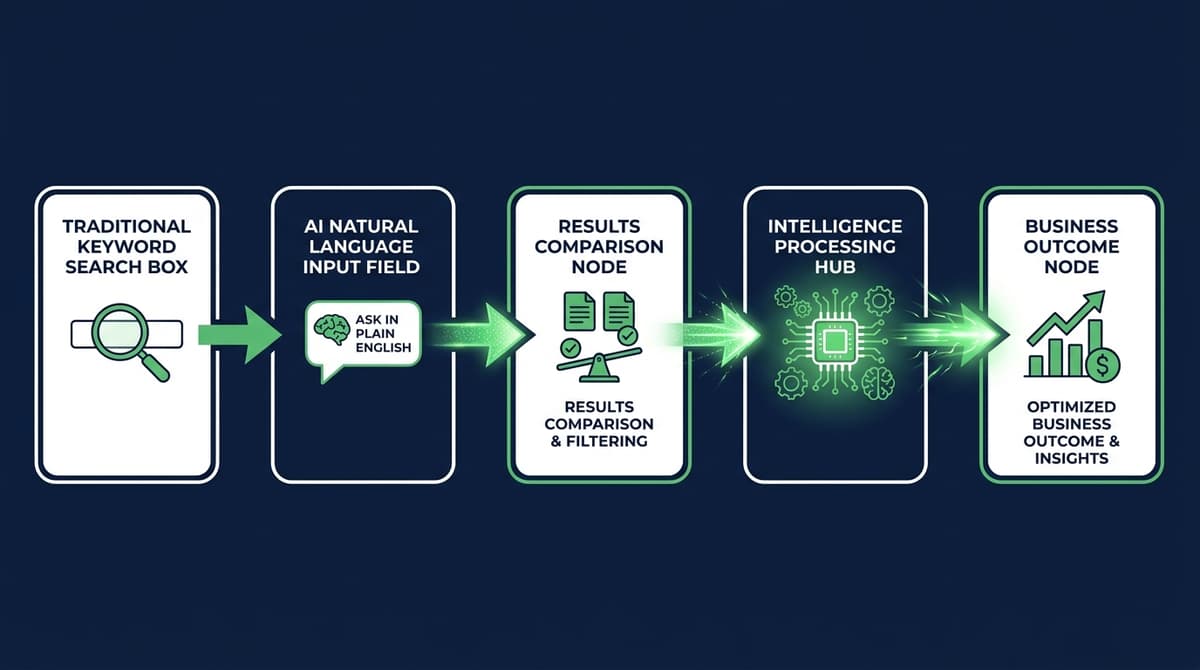
Search in Australia split into two lanes. One is the search you grew up with: type a query, get a page of links, click one. The other is AI search, where a chatbot or an AI answer box reads the web for you and writes back a single answer with a handful of sources attached. Traditional search is when a search engine returns a ranked list of links and you choose one yourself. AI search is a way of finding information where a large language model reads several pages and hands you the conclusion. Gartner expects traditional search-engine volume to drop about 25% by 2026 as people lean on AI chatbots and assistants instead. For a small business in Melbourne or Brisbane, that means the people who used to find you on page one of Google might never see a list of links at all.
This guide is part of UnderCurrent's SEO and AI visibility hub for Australian businesses, and it does three things: it lays out what actually changed when AI search arrived, what still works from classic SEO, and which old tactics are now dead weight. It also folds in the "AI SEO" question, because there's no separate AI SEO playbook, just SEO with two extra jobs. No jargon, no doom-mongering, just the bits you can act on this month.
| What you're doing | Traditional search (Google links) | AI search (ChatGPT, Gemini, AI Overviews) |
|---|---|---|
| Finding an answer | Ten blue links, you pick one | One written answer with a few cited sources |
| What "winning" looks like | Ranking on page one | Getting named inside the answer |
| The metric that matters | Clicks and sessions | Citations, mentions, AI referral visits |
| Content it rewards | Keyword-matched pages, backlink count | Direct answers, fresh proof, clean structure |
| What it quietly ignores | Old pages with weak signals | Thin keyword pages, doorway pages, link spam |
What Changed When AI Search Arrived for Australian Businesses?
An answer now sits between your customer and your website, and most of the time nobody clicks through it. Bain & Company found that around 80% of search users now rely on zero-click answers, like AI summaries, for at least 40% of their searches, and roughly 60% of searches end without the person visiting another site at all (Bain & Company). That tracks with the older zero-click trend: nearly 6 in 10 Google searches in 2024 ended without a click to the open web (Search Engine Land). Answer engine optimisation refers to the work of getting your business quoted inside those AI-written answers, not just ranked below them. The shift is structural, not a fad. Google now runs AI Mode and shows AI Overviews across more than 200 countries and 40-plus languages, where they've lifted usage by roughly 10% for the queries that show them (Google), and ChatGPT search opened to all logged-in users within 2 months of its October 2024 launch (OpenAI). If you want the deeper version, UnderCurrent's guide to what AI search optimisation actually involves breaks it down step by step. For an Australian small business, that means discovery moved into the answer, and you need to be in it.
How Is AI Search Different From Traditional Search?
The difference is how the system decides what to show you. Traditional search builds an index, ranks pages by relevance and authority, and hands you a list. AI search adds two moves on top: it retrieves a shortlist of sources, then a language model reads them and writes one answer, citing a few. Generative engine optimisation is the practice of shaping content so AI answer engines quote it. That changes the prize. On Google, position one still earns the click, but when an AI Overview appears above the results, clicks to the top organic listing drop by about 34.5% (Ahrefs), and roughly 60% end without a click anyway. In a chatbot like ChatGPT, used by hundreds of millions of people each week, there often isn't a results page at all, just the answer and its sources. So the question moves from "do I rank?" to "am I one of the sources this answer trusts?" UnderCurrent's guides on how to rank in ChatGPT search and how to rank on Google in Australia cover both. Two judges, two ways to get picked.
What Still Works From Traditional SEO in 2026?
Most of the SEO fundamentals still earn their keep, because AI engines read the same web everyone else does. Helpful, first-hand content still wins: Google's own guidance still tells you to write people-first pages with real experience behind them (Google Search Central), and AI answer engines pull from those same pages. Clean technical health still matters: a page an AI crawler can't read can't be cited. Internal links still pass context, so AI models understand how your pages relate. Real entities still count: a consistent name, a real address, genuine reviews, trusted citations. And the demand is real, not theoretical. Around 49% of Australians used a generative AI tool in the past 12 months, up from 38% in 2023 (Google), a jump of roughly 28% in one year. Australians punch above their weight on ChatGPT too, around 2% of global visits from a country with 0.33% of the world's people. A fast way to sanity-check the foundations: run an SEO self-check. The fundamentals didn't break. They just stopped being enough on their own.
Which Traditional SEO Tactics Are Dead in AI Search?
A short list of old tactics now works against you, because AI engines reward clarity and punish padding.
The dead tactics
- Keyword density is dead: stuffing a phrase in 14 times tells a language model nothing useful.
- Exact-match doorway pages are dead: 200 near-identical "[service] in [suburb]" pages with no real content read as spam to both Google and AI engines.
- Buying links is dead, and was already on the way out.
- Thin "10 best X" listicles with no first-hand testing are dead, because an AI summariser can rewrite them in seconds and won't bother citing one.
- Meta-keyword stuffing has been dead for a decade and still turns up.
The pattern: anything built to game a ranking rather than answer a question. With around 60% of Google searches ending without a click (Search Engine Land), there isn't traffic to catch with a thin page anyway. If you're weighing up help with this, UnderCurrent's note on picking an AI search agency in Australia lists what good looks like. Cut the tactics that exist only to trick a crawler.

Is "AI SEO" Different From Traditional SEO?
AI SEO isn't a separate discipline, it's SEO with two extra jobs added to the old list. Job one: be quotable. Lead each section with the answer, write plain sentences a model can lift cleanly, back claims with specifics. Job two: be a strong entity. Make sure your business name, services and proof are consistent everywhere a model might check, so the AI is confident it's quoting the right Melbourne or Perth business. Two named practices sit under that umbrella. Answer engine optimisation, explained in plain English is about getting cited inside AI Overviews and chatbot answers. Generative engine optimisation, explained for Australian businesses is the broader version, shaping content so generative engines retrieve and quote it. Both run on the same engine room as classic SEO: helpful content, clean tech, real authority. So you don't need a second website, a second strategy, or a budget line called "AI". You need your existing SEO to also pass the "would an AI quote this?" test. One content system, doing two jobs.
What We Learned Auditing Australian AI-Search Articles
When we audit competitor and our own articles on the same yardstick, the AI-search content most Australian businesses publish scores worse than the headlines suggest. Across 72 articles from 47 different hosts in this vertical, scored on the UnderCurrent Article Reviewer rubric, version 2.0.0, the average came in at 55 out of 100, with a range from 27 to 90.
Three things hit harder than that average suggests
- The floor is low: 49 of those 72 pages landed in the weak band of 30 to 59, and fewer than 1 in 10 cleared 80, so the bar to stand out is lower than people assume.
- The gap is real: across the full corpus of 146 articles we've reviewed, the mean is 52.8, while our own articles average 81.1 over 11 pieces, and the difference is mostly structure and proof, not word count.
- The cheap wins are everywhere, a missing FAQ block, a buried answer, no schema.
You can see one worked example in this Melbourne plumbing SEO case study. Most pages aren't bad. They're just unfinished.
How Do You Win Both AI Search and Traditional Search in Australia?
One content system, two payoffs, if you build pages that answer cleanly and prove their claims.
Five moves cover most of it
- Answer first: every section opens with the takeaway, so a model can quote it without hunting.
- Add structured data: mark up FAQs and articles so engines parse your content reliably.
- Fix entity consistency: same business name, address and service list everywhere, plus genuine reviews.
- Publish first-hand proof: numbers, examples and observations a competitor can't copy, since an AI summariser can rewrite generic content, not your data.
- Track citations: check whether ChatGPT, Gemini and Google's AI Overviews are naming you.
Here's a starter FAQ schema block you can adapt and drop into a page's <head>:
<script type="application/ld+json">
{
  "@context": "https://schema.org",
  "@type": "FAQPage",
  "mainEntity": [
    {"@type": "Question", "name": "What is AI search?",
     "acceptedAnswer": {"@type": "Answer",
       "text": "AI search is when a language model reads the web and writes one answer, citing a few sources."}},
    {"@type": "Question", "name": "Is traditional SEO still worth it in 2026?",
     "acceptedAnswer": {"@type": "Answer",
       "text": "Yes. Helpful content, clean technical health and strong entities still drive AI citations."}}
  ]
}
</script>
If you'd rather have someone do the build, UnderCurrent's SEO and AI visibility work or a free AI search audit is a fast way to see where you stand. For a niche walkthrough, see how a Melbourne buyers agency ranks on AI search and GEO for buyers agents in Australia. Build it once, get cited twice.
How Should an Australian Small Business Start This Week?
Start small, with one engine and your three best pages, not a full rebuild.
Your first week
- Pick the engine your customers actually use, usually ChatGPT or Google's AI Overviews, and search a few real service-plus-suburb queries to see who gets named, Day one
- Take your three highest-value pages and rewrite the opening of each section so the answer comes first, in plain language, Day two
- Add FAQ and article schema to those pages, using questions real customers type, Day three
- Tidy up your business name, address and service list so they match across your site, Google Business Profile and any directories, Day four
- Set a reminder every 30 days to re-run the citation check, Day five
Five focused jobs, for about $0 in tools. If you want a shortlist of help, UnderCurrent's guide on how to compare AI search agencies in Australia is a good filter, what AI automation means for small business shows where this connects, and you can talk to the UnderCurrent team if you'd rather not DIY. One week, one engine, three pages.
Sources
- Gartner: Search Engine Volume Will Drop 25% by 2026, Due to AI Chatbots and Other Virtual Agents
- Bain & Company: Goodbye Clicks, Hello AI, Zero-Click Search Redefines Marketing
- Search Engine Land: Nearly 60% of Google searches end without a click in 2024
- Google: AI Mode in Google Search, updates from Google I/O 2025
- OpenAI: Introducing ChatGPT search
- Ahrefs: AI Overviews reduce clicks by 34.5%
- Google: AI adoption in Australia, new survey reveals increased use and belief in potential
- Google Search Central: Creating helpful, reliable, people-first content
Frequently asked questions
How do I check if ChatGPT or Google's AI is citing my business?
Ask the AI engines the way your customers do. In ChatGPT, Gemini or Google's AI Overviews, type a handful of your real "service in suburb" queries and read who gets named and linked in the answer. Note whether it's you, a competitor, or a directory. Do this monthly for your top five queries. It's the cheapest AI visibility check there is, and it tells you whether the work is landing without needing a paid tool.
Does my Australian small business need a separate website for AI search?
No. You don't need a second website, a second blog, or an "AI version" of anything. AI engines read the same pages Google does, so the work happens on your existing site: answer-first content, FAQ and article schema, consistent business details, real reviews and proof. A separate site just splits your authority in half. Spend that effort making your current pages quotable instead. One strong site beats two thin ones every time, in both lanes.
How long does it take to show up in AI search results?
It varies, but most businesses see movement within 8 to 12 weeks of fixing the basics, not in 2 or 3 days. AI engines re-crawl your updated pages, and chatbots pull from a search index that updates on roughly Google's timeline. Brand-new domains take longer because there's less trust to draw on. The fastest wins come from rewriting existing pages that already rank, since the authority already exists, you're just making the content easier to quote.
Do backlinks still matter for AI search rankings?
Yes, but as one signal among several, not the whole game. AI engines still use links to gauge whether a site is trusted, the same way traditional search does. What's changed is that buying links or chasing low-quality ones does nothing useful, and it never really did. Genuine mentions from sites your customers recognise, plus citations in industry publications, still help an AI decide you're a credible source. Earn links by being worth citing, not by trading for them.
Which AI search engine should an Australian business focus on first?
Start with whichever one your customers already use, and for most that's ChatGPT or Google's AI Overviews. ChatGPT has hundreds of millions of weekly users, with about 2% of global traffic from Australia, so it's a safe first bet. Google's AI Overviews matter because they sit on searches people already do. Pick one, get your top pages quotable there, then widen out. Chasing every engine at once on a small budget spreads you too thin.
Will Google search traffic disappear by 2026?
No, but it shrinks. Gartner expects traditional search-engine volume to fall about 25% by 2026 as more people use AI chatbots and assistants (Gartner). Google still handles the majority of searches, and AI Overviews keep many of those searches inside Google rather than killing them. The honest read: Google traffic is still the biggest single channel, it's just no longer the only one, and the slice that ends without a click keeps growing. Plan for both.