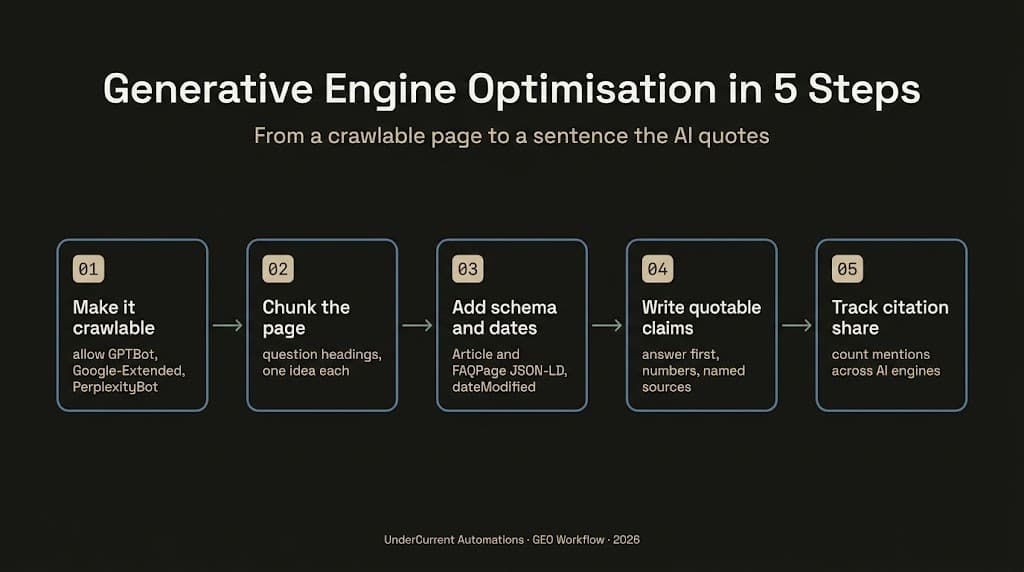
If you've read our explainer on answer engine optimisation, you already know the headline: AI now answers questions instead of just listing links, so the job is to be the source it leans on. This piece zooms in on one slice of that job, and pairs with our short glossary definition if you want the 30-second version first. We're not going to re-argue why AI search matters, the AEO guide does that. We're going to define generative engine optimisation properly, show how it differs from SEO and answer engine optimisation, and walk through what it actually takes for a ChatGPT or Gemini answer to quote your business by name. If you run a service business in Melbourne, Sydney, Brisbane, Perth, Adelaide or anywhere else in Australia, this is the channel quietly deciding who gets recommended.
What Is Generative Engine Optimisation?
Generative engine optimisation is the practice of structuring, sourcing and dating your content so AI engines can retrieve it, trust it, and quote it back to people who never visit your site.
The term comes from a 2024 research paper that coined it, which tested nine ways to make a page more quotable in AI answers and found the biggest gains came from adding cited sources, direct quotations and concrete statistics, not from stuffing keywords. That matches what Google's guidance on AI features in Search keeps stressing: people-first content, clearly written, with the expertise on display.
In plain terms: an AI engine reads a question, pulls a handful of web pages it can parse, and writes a short answer that blends them. GEO is everything you do so your page is one of that handful, and so the sentence the engine lifts is yours, with your business named in it. It takes about 5 minutes to read a guide like this; it takes a few months to do the work.
One caveat: GEO doesn't replace SEO. Around 65% of organisations now use generative AI regularly in at least one business function, according to McKinsey's state of AI research, but most of your customers still use Google the old way too. GEO is a second layer on top, not a swap.
How Does GEO Differ from SEO and Answer Engine Optimisation?
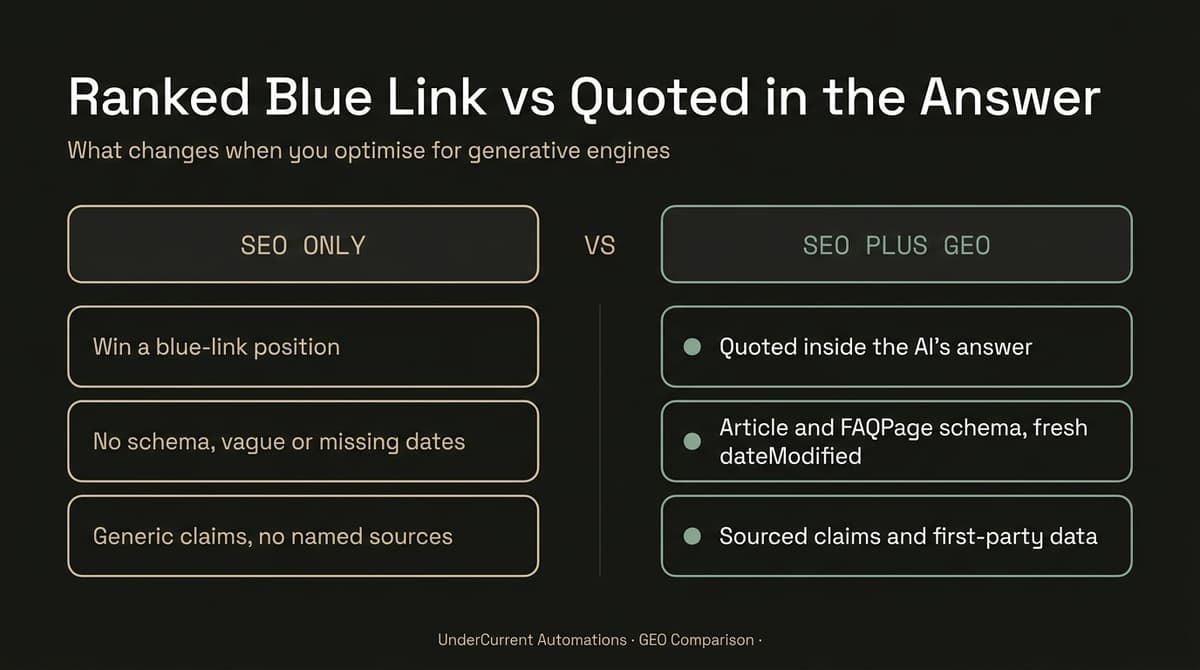
SEO ranks the blue link, AEO wins the answer box, GEO gets quoted inside the answer the AI writes. Three layers of one job, not three rivals.
Search engine optimisation is the older craft of ranking a page in a list of links: keywords, backlinks, on-page structure. Answer engine optimisation is the discipline of being picked as the single direct answer (a featured snippet, a voice reply) through question headings, short answers and FAQ schema (schema.org's FAQPage type).
GEO is the newest layer and the only one with no real SEO twin: a generative engine doesn't crown one winner, it blends a few sources into new prose, so GEO optimises for being one of those sources. The full head-to-head is coming in a dedicated AEO-vs-SEO-vs-GEO comparison; our buyers' agency GEO walk-through shows it in one Australian niche. The one-line version:
| Layer | The win | Main lever |
|---|---|---|
| SEO | A blue-link ranking | Keywords, links, page speed |
| AEO | The answer box | Question headings, FAQ schema |
| GEO | A quote in the AI's answer | Retrievable, fresh, sourced pages |
Takeaway: keep doing SEO, add AEO discipline, treat GEO as the new top layer. Our answer engine optimisation guide covers the AEO half.
Which AI Engines Does Generative Engine Optimisation Target?
GEO targets the engines that generate prose answers rather than list links: ChatGPT, Google's AI Overviews and Gemini, Perplexity, and Microsoft Copilot, and the thing they share is that they pull live web pages to ground what they say.
An AI Overview is the summary box Google now shows above the blue links for many questions, written by Gemini and stitched together from pages it retrieves. Google has expanded AI Overviews to more than 100 countries since the 2024 US launch; Google's Search blog has the rollout history. Gartner expects search engine volume to fall around 25% by 2026 as people lean on AI chatbots, so being one of the pages they retrieve is now its own job.
Where they ground their answers matters for GEO. ChatGPT and Copilot run live web searches and cite the pages they used. Perplexity is built around showing its sources. Gemini powers AI Overviews and Google's AI Mode. Claude can browse the web and read pages too. The common pattern under the hood: a search step, a retrieval step, then a generation step that quotes a few of the retrieved pages. Optimise for that pattern and you're optimising for all of them at once. For the wider view across these channels, our AI search optimisation guide for Australia covers the lot.
What Makes Your Content Retrievable by a Generative Engine?
A generative engine can only quote what it can fetch, parse and trust, so retrievability is the part of GEO with no SEO twin: clean chunks, schema markup, fresh dates, and a site that doesn't block the crawlers.
Retrieval-augmented generation is the technique most AI engines use to ground an answer; they search, pull a few documents, and feed those to the model alongside your question. Your page has to survive that pipeline. Four levers do most of the work:
- Chunkable structure. Short sections under question-shaped headings, one idea each, so a retriever can lift a clean self-contained passage instead of a tangled paragraph.
- Schema markup. Article and FAQPage JSON-LD so machines know what the page is and who wrote it (schema.org's Article type). A basic Article block takes about 10 minutes to add and looks like this:
{
  "@context": "https://schema.org",
  "@type": "Article",
  "headline": "What Is Generative Engine Optimisation? GEO Explained",
  "datePublished": "2024-04-21",
  "dateModified": "2026-05-12",
  "author": { "@type": "Organization", "name": "UnderCurrent Automations" },
  "publisher": { "@type": "Organization", "name": "UnderCurrent Automations" },
  "about": "Generative engine optimisation",
  "isAccessibleForFree": true
}
- Freshness. A visible publish date and an honest
dateModified. Refresh anything important every 90 days; a page untouched in 12 months reads as stale, while a fresh update can get re-crawled within 24 hours. - Crawlability. Don't block GPTBot, Google-Extended or PerplexityBot in robots.txt if you want to be quoted. An
llms.txtfile pointing to your best pages doesn't hurt either. The on-page basics here cost $0 beyond a couple of hours of your time.
How Do You Earn a Citation in an AI-Generated Answer?
You earn a citation by being the most quotable sentence on the topic: a short, sourced, self-contained claim an AI can lift verbatim without having to rewrite it.
When an engine assembles an answer, it favours passages that are directly responsive, backed by a named source, specific with numbers, and recently dated. So write the answer first, then the context. Lead each section with a one-sentence answer. State numbers plainly with a link, the way you'd want to be quoted: small businesses make up about 97% of all Australian businesses (Australian Small Business and Family Enterprise Ombudsman), and there are more than 2.5 million of them trading (Australian Bureau of Statistics).
The biggest unfair advantage is your own data. A first-party number an AI can't pull from a competitor, a benchmark from your audits, a result from your own work, gets quoted because nothing else online says it. Compare-and-contrast content gets pulled hard too, "X vs Y" pages map straight onto the questions people type into AI engines. And keep it current: a claim with a 2026 date beside it beats the same claim with no date at all. Our AEO explainer breaks down the answer-box half of this.
How Is Generative Engine Optimisation Performance Measured?
GEO performance is measured by how often you show up in AI answers, not by where you rank, citation share, AI-referral traffic and branded-search lift are the three numbers worth tracking.
Citation share is the headline metric. Run your key questions through ChatGPT, Gemini, Perplexity and Copilot on a schedule and count how often you're named versus competitors; a spreadsheet works to start, and there are tools that automate it. Spot-check it every 7 days while you're actively working on a topic. AI-referral traffic is the second: in Google Analytics, filter referrals from chatgpt.com, perplexity.ai, gemini.google.com and copilot.microsoft.com. It's still a sliver of total traffic, but a fast-growing sliver, and it converts well because the visitor arrived pre-sold by the AI.
Branded-search lift is the third and most underrated. When AI engines mention you, more people then search your name directly, so watch branded-query volume in Search Console; a rise after AI exposure means GEO is working. One caveat: don't expect overnight numbers. The quick wins land in 2 weeks, but plan on 3 to 6 months for citation share to move on a competitive topic, and give it 3 months before you judge anything. Google's AI-features guidance is blunt about it: there's no special trick, just well-made content.
What We Learned Auditing Australian AI-Search Pages
We audited 69 Australian service-business pages against the rubric we use for client work, and the median came in at 58 out of 100, most local sites are leaving generative-engine visibility on the table.
What surprised us when we ran the numbers
Three things hit harder than the bare numbers suggest. First, the gap is wide and lopsided: across 37 different sites, scores ran from 30 to 90, but barely 1 in 7 landed in the strong band (80 and up), roughly 1 in 3 sat in the competent middle, and more than 1 in 2 were stuck in the weak band. Second, the fixes are cheap, the pages at the bottom were usually missing the basics, no schema, no clear publish date, no quotable stat, and about 30 minutes of work on each closed most of the gap. Third, our own articles score the way you'd expect when you actually do the work: across the 11 UnderCurrent pages in that set the mean was 81 out of 100, well clear of the 53 out of 100 average across every page we've scored. The lesson isn't "AI is hard". It's that almost nobody locally is doing GEO yet, so the bar to clear is low, for now.
Frequently Asked Questions
Do I still need traditional SEO if I'm doing generative engine optimisation? Yes. Generative engine optimisation sits on top of SEO, it doesn't replace it. Most of your customers still use Google the normal way, click a link and read the page, and a page that ranks well is also one AI engines are more likely to retrieve and quote. Treat GEO as a third layer after on-page SEO and answer engine optimisation, not a swap. Retrievability and ranking pull in the same direction.
How long does generative engine optimisation take to show results? Plan on 3 to 6 months for your citation share to move on a competitive topic, with the quick wins landing in the first few weeks. Adding schema, fixing publish dates and tightening your key answers can be picked up on the next crawl. Building enough quotable, well-sourced pages that you become a regular source is the slower part. Either way: months, not days, but faster than SEO ever was.
Can a small business do generative engine optimisation without an agency? Yes, the basics are very doable solo. Add Article and FAQPage schema to your main pages, put a real publish date and an honest "last updated" date on each, rewrite your top pages so the answer comes first, and don't block AI crawlers in robots.txt. That covers most of it. An agency mostly earns its keep on the ongoing part: tracking citation share, refreshing pages on a schedule, and building enough sourced content to be a default source.
Does generative engine optimisation only work for big brands, or can local service businesses compete? Local service businesses can absolutely compete, and right now it's easier than it looks. When we audit Australian service-business sites, most score around the middle on AI-search readiness, which means the bar to stand out is low. AI engines aren't picking the biggest brand; they're picking the clearest, best-sourced, freshest answer to a specific question, and a focused local business that does the work can beat a national competitor that hasn't bothered. The window won't stay open forever.
Is "generative engine optimisation" just a new name for "AI SEO"? Mostly, yes, they point at the same work. "AI SEO", "GEO", "AEO" and "LLM optimisation" are competing labels for getting your content surfaced by AI answer engines. The terms aren't standardised and people draw the lines differently. We use "generative engine optimisation" for engines that generate prose answers, and "answer engine optimisation" for answer boxes and snippets (see our AEO explainer). Don't get hung up on the name; focus on whether the AI quotes you.
Will optimising for AI answers hurt my Google rankings? No, the two reinforce each other. The things that make a page quotable by AI engines, clear structure, schema markup, fresh dates, real expertise, hyperlinked sources, are the same things Google's helpful-content guidance has asked for all along, and they help traditional rankings too. There's no trade-off where you sacrifice rankings to win AI citations. The one thing to avoid is thin AI-generated filler made purely to chase citations. Make useful, sourced pages instead.
Related Reading
- What is answer engine optimisation? AEO explained: the parent pillar on how AI answer engines work and how to be the answer box, not just a result.
- Generative engine optimisation for buyers' agents in Australia: a worked example of GEO applied to one competitive local niche.
- What is AI search optimisation? An Australian guide: the wide-angle view across AI Overviews, ChatGPT, Gemini and Perplexity.
- AI automation for Australian businesses: where AI search visibility fits into a broader AI strategy. City pages: Melbourne, Sydney, Brisbane, Perth and Adelaide.
- More on AI search and automation on the UnderCurrent blog. A primer on AI strategy training if you want your team across this, and more on the team behind these audits at UnderCurrent Automations.
Sources
- Google Search blog on AI in Search
- Google Search Central: AI features and your site
- Schema.org Article type
- Schema.org FAQPage type
- Gartner: search engine volume to fall by 2026 as AI chatbots grow
- McKinsey: The state of AI
- GEO: Generative Engine Optimization (research paper, 2024)
- Australian Bureau of Statistics: Counts of Australian Businesses
- Australian Small Business and Family Enterprise Ombudsman