

AEO vs SEO vs GEO: Pick the One That Gets You Found
Quick answer
SEO ranks your page in Google's links, AEO lets search engines lift a one-line answer from it, and GEO gets your business named in AI answers.
- AEO answers show in Google, Siri and People Also Ask
- GEO answers are written by ChatGPT or Perplexity
- You don't pick one
- Build in order: SEO first, AEO next, GEO last

If your agency is pitching AEO vs SEO vs GEO as three separate line items on the invoice, here's the page that sorts out which one actually makes your phone ring. Three letters apart. Very different work. Same job.
We've audited the AI-search visibility of 69 articles across 37 Australian websites, and the gap between the pages that show up in AI answers and the ones that don't almost never comes down to which acronym the agency sold. It comes down to whether the basics were done at all. Here's the plain version, the money behind it, and the three-layer check you can run this week.
AEO vs SEO vs GEO: The Plain-English Version
All three are ways of getting found. They just aim at different places a buyer might land.
SEO is the discipline of earning a spot in a search engine's ranked list of links, the ten blue results you scroll on Google. AEO is the practice of structuring a page so an answer engine can lift a direct response off it, the bit that shows up in a featured snippet, an AI Overview, or out of a voice assistant. GEO is the work of getting your business named and quoted inside an answer a generative model writes from scratch, the kind you get from ChatGPT search, Gemini or Perplexity.
GEO is short for generative engine optimisation, sometimes called AI search optimisation, and it's a real discipline, not a rebrand of SEO. Schema markup is a shared vocabulary that labels the parts of a page so machines read it the way a person would, and it sits underneath both AEO and GEO. Our full breakdown of answer engine optimisation goes deeper on the AEO side, and what AI search optimisation means for Australian businesses covers the GEO end. This page is the comparison, and the short version is: the same three pages get found everywhere or get found nowhere.
How Much Are Australian Businesses Spending on This?
A lot. And it's still mostly going to plain old SEO.
Australian businesses are tipped to spend about $1.5 billion on SEO services in 2025, up roughly 12% on the year before, and the typical small business pays around $1,200 a month for it. Roughly 74% of small businesses invest in SEO at all, the average service runs about $497 a month worldwide, and 63% report a positive impact from Google's AI Overviews on their organic traffic. Those numbers come from recent Australian SEO spend data.
There's a lot of ground to fight over, too. More than 97% of all Australian businesses are small businesses, about 2.7 million of them, on the ASBFEO's small business figures.
Most of those aren't doing layer one properly, which is exactly why doing AEO and GEO well is a cheap edge right now, while the budgets going into the newer two are still tiny. See how AI search stacks up against traditional search for the trend lines.
What Does SEO Actually Change on Your Page?
SEO is the layer everything else sits on, so it's the one to get right first.
In practice it touches five things: words on the page, links pointing at it, technical plumbing, page speed, and local signals. You write content that actually answers the query, you earn links from sites Google trusts, you make the page crawlable with clean titles and headings, you get it loading in a couple of seconds on a phone, and for a local business you keep your Google Business Profile and your name, address and phone consistent everywhere. Google's own SEO starter guide still leads with the same fundamentals it did years ago: useful content, a site search engines can read, descriptive titles.
It's the slow-compounding layer. A page that earns a top ranking often holds it for 2 years or more, which is why it's still where most search budget goes. If you want to know where your own site stands, our free SEO foundations self-check walks through it, or read how to rank on Google in Australia for the longer version.
What Does AEO Actually Change on Your Page?
AEO is mostly a formatting and structure job, not a brand-new content strategy.
The work is: phrase headings as the questions buyers actually type, put a tight 40-to-60-word answer right under each one, run a real FAQ section, and add schema markup so crawlers know what they're looking at. You name entities clearly, you use lists and tables where they help, and you write the takeaway in the first sentence so an answer engine can grab it without hunting. Google's structured data documentation is the canonical reference, and the FAQPage type on schema.org is the one most service businesses start with.
None of it helps if the page isn't already pulling its weight in normal search, which is the whole point of building SEO first. For the difference spelled out, see how AI search differs from traditional SEO in Australia. An Australian guide to answer engine optimisation makes the same case: AEO is a layer on top, not a replacement.
What Does GEO Actually Change on Your Page?
GEO is less about your page and more about your reputation across the web.
A generative engine doesn't rank pages, it writes an answer and decides which businesses to name in it. So GEO is about being the business other credible sites already talk about: mentions on directories and industry pages, reviews that describe what you do, consistent entity data, and content quotable enough to land in the sources an AI tool pulls from. There's also a measurement side: you can't see your "share of model" the way you see a ranking. You might be named in 1 in 5 relevant AI answers one month, 1 in 10 the next, 1 in 20 the one after, and most businesses can't tell. The winners here treat it as a tracking problem first.
The practical starting point is the same checklist that helps SEO: findable, consistent, quotable. We pulled apart a real example in GEO for buyers' agents in Australia, and how to rank in ChatGPT search covers the chatbot side.
AEO vs SEO vs GEO: The One-Table Comparison
Here's the whole thing on one screen.
| Layer | What it targets | Where you show up | Best for the business that... |
|---|---|---|---|
| SEO | Ranked links | Google's blue results, Maps pack | needs steady search traffic |
| AEO | Direct answers | Featured snippets, AI Overviews, voice | gets asked specific questions buyers Google |
| GEO | Citations in AI replies | ChatGPT, Gemini, Perplexity | wants the AI to name it |
| All three | Visibility top to bottom | The whole results page | has a long buying decision |
Read the last column first, it tells you where your money goes. A tradie chasing emergency jobs, where the buyer picks one of the first 3 results in 10 minutes, starts with SEO and local. If buyers Google "how much does X cost" first, AEO earns its keep fast. A plain rundown of SEO, GEO and AEO covers the split. How to compare AI-search agencies helps if you're quoted for all three.

Which One Comes First, SEO or AEO?
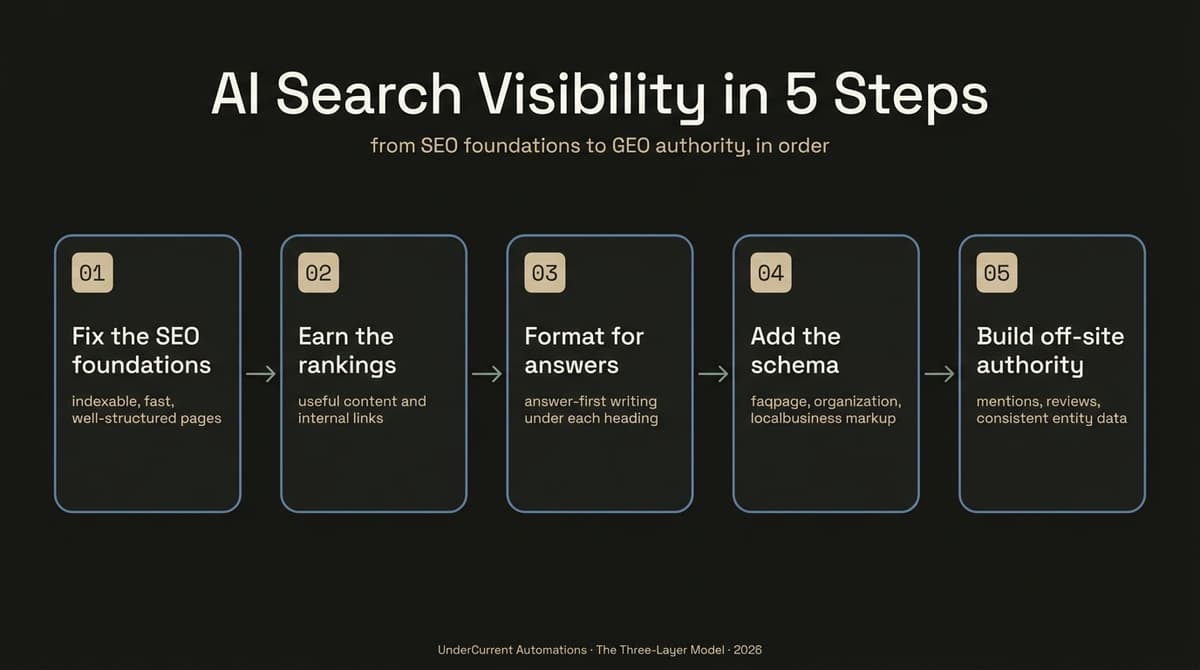
SEO first, always, because AEO is a layer that sits on top of pages that already work.
You can't get lifted into an AI Overview if the page isn't indexed and ranking, so the order is:
The order, layer by layer
- Build the page.
- Earn the ranking, which takes 6 to 9 months on a competitive term and 2 to 3 months on a quiet one.
- Format it for extraction.
- Build the off-site authority GEO needs.
There's one exception. A brand-new site with no content does the SEO and AEO basics at the same time, because clear structure, useful answers and clean schema help both at once, so there's no point staging them. In our own audit corpus, the pages that show up in AI answers are almost always the ones already ranking on page one, not the ones with the fanciest schema bolted onto thin content. For what AEO, GEO and the rest of the alphabet actually mean, see this rundown of the 2025 search acronyms, then run the free self-check before you spend a cent on AEO.
Which Layer Matters Most for a Local Service Business?
For most local service businesses, the order is SEO and local signals first, AEO close behind, GEO when there's budget to spare.
Think about how the job arrives. Someone searches "emergency electrician" plus their suburb, or asks their phone who does pre-purchase inspections nearby, and calls one of the first names back within 5 minutes. That's local SEO doing the heavy lifting: Google Business Profile, reviews, location pages, consistent contact details. AEO comes in for the questions buyers research before they commit, the cost questions and the "do I even need this" questions, where a clean answer on your page can win the click. GEO matters less for hyper-local work today, though it's growing. We ran exactly this order for our South-East Melbourne plumbers case study: SEO foundations and local signals first, AEO formatting on the high-intent pages, GEO parked for later. If the admin side of running a trades business in Melbourne is eating your week too, that's a separate fix.
What Does AEO Look Like in Your Page Code?
Strip away the jargon and AEO mostly comes down to two things: answer-first writing, and a bit of schema.
Answer-first writing means the first sentence under a heading is the answer, not a wind-up, so a machine reading the page can grab it cleanly. Schema is the structured data that spells out what that answer is. Here's the FAQ schema most service businesses start with:
{
  "@context": "https://schema.org",
  "@type": "FAQPage",
  "mainEntity": [{
    "@type": "Question",
    "name": "Is AEO the same as SEO?",
    "acceptedAnswer": {
      "@type": "Answer",
      "text": "No. SEO earns your page a spot in the ranked list of links. AEO formats that page so an answer engine can lift a direct response off it. AEO sits on top of SEO."
    }
  }]
}
Drop that into the page and you've told Google, Bing and the AI crawlers behind ChatGPT and Perplexity exactly which question you answer and what the answer is. It's the difference between a page a crawler has to interpret and one that hands over a labelled answer. Pair it with Organization and LocalBusiness markup so the machines know who you are and where you work, and that's the bulk of AEO done. For the full version, the AI-search visibility hub collects everything.
The 3-Layer Audit You Can Run This Week
You don't need a paid tool to see whether your site is doing any of this.
Work down the layers and tick what's true. Three ticks per layer is the bar, and be honest with the boxes: a page that loads in 4 seconds doesn't get a tick for "under 2 seconds", and "sort of has schema" is a no.
Layer 1: SEO foundations
Layer 2: AEO formatting
Layer 3: GEO authority
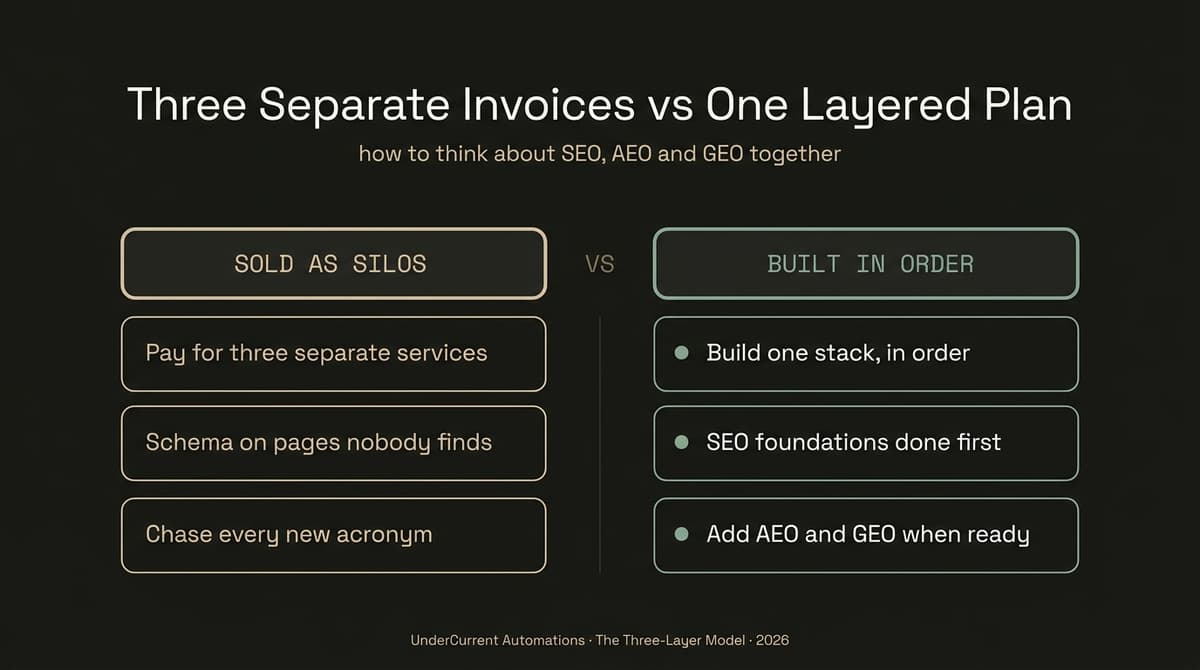
The whole sweep takes about 30 minutes. If layer one has gaps, fix that before you touch anything else, because schema on a page nobody can find is just decoration. If you'd rather have someone score all three for you, we run a free SEO, AEO and GEO audit, one report, three layers, no upsell pressure, off our AI search visibility page, or work through the full self-check walkthrough yourself first.
What Surprised Us When We Audited 69 Australian Sites
Three things hit harder than the score sheet alone shows.
The three things
- The scores are low across the board. Of the 69 articles we audited against the UnderCurrent Article Reviewer rubric, version 2.0.0, the median landed at 58 out of 100, and 38 of them sat in the weak band below 60. Only 9 cleared 80.
- The gap almost never came from missing schema or clever GEO tactics. It came from thin content and broken internal links, which is plain old SEO.
- The pages that did show up in AI answers were, with very few exceptions, the ones already ranking on page one. AEO and GEO never rescued a weak page, they amplified a strong one.
Our own articles average about 81 out of 100, and that's the whole trick: do layer one properly, and the other two become worth doing. We've been tracking these scores for 12 months and the pattern hasn't shifted. Want the longer version? Read how AI search differs from traditional SEO in Australia, or browse more from our AI-search visibility series.
Do You Need an Agency for This, or Can You DIY?
Layer one and most of layer two you can do yourself with a free afternoon and the checklist above. Layer three is where outside help usually earns its fee.
The DIY scope is real: claim and fill out your Google Business Profile, about 20 minutes of work, add basic schema with a plugin, rewrite your key pages answer-first, run the self-check. Where it gets hard is technical SEO on a messy site, producing content at any scale, building genuine off-site authority, and tracking whether AI tools actually name you. That's the work that tends to need a team, and you can see how we work with clients if that's the route you're weighing. If you're getting quotes, the test is simple: ask them what's actually different between the three services they're charging for, and what they'd do first. If the answer isn't "fix the SEO foundations", be careful. How to compare AI-search agencies in Australia helps you read a proposal properly.
Sources
- Australian SEO and content marketing statistics for 2025
- ASBFEO small business figures
- ASBFEO small business data portal
- Google Search SEO starter guide
- Google structured data documentation
- FAQPage type on schema.org
- Organization type on schema.org
- LocalBusiness type on schema.org
- An Australian guide to answer engine optimisation
- What is SEO, GEO and AEO
- What AEO, GEO, AIO and SXO actually mean
Frequently asked questions
Is GEO the same as generative engine optimisation?
Yes. GEO stands for generative engine optimisation, and some people call it AI search optimisation or generative search optimisation. It's the work of getting your business named and quoted inside the answers tools like ChatGPT, Gemini and Perplexity write from scratch, rather than the ranked list of links you get from a traditional search. It overlaps heavily with SEO and AEO, but the target is a generated answer, not a results page.
Can a small business skip GEO for now?
For most small and local businesses, yes, at least for a while. GEO is the lowest-priority layer today because the volume of buyers finding you through a chatbot is still small next to normal Google search and Maps. Get your SEO foundations and local signals right, add AEO formatting on your high-intent pages, and you're most of the way there. Revisit GEO once the first two layers are solid and there's budget for off-site authority.
Does schema markup help with AI search?
Yes, schema markup is one of the most direct things you can do for AI search. Schema is structured data that labels the parts of your page, the questions you answer, who you are, where you operate, so a crawler reads it without guessing. FAQPage, Organization and LocalBusiness are the three types most service businesses should add first. It doesn't replace good content, but it makes the content you have far easier for answer engines and AI models to use.
What's the difference between AEO and GEO?
AEO and GEO are easy to confuse, but they aim at different surfaces. AEO is about getting a direct answer lifted from your page into a search feature, a featured snippet, an AI Overview, the People Also Ask box, or a voice assistant. GEO is about getting your business cited inside the freeform answer a generative model writes, like a ChatGPT or Perplexity reply. AEO is mostly on-page formatting and schema. GEO leans more on off-site authority and being quotable.
Is SEO still worth it with AI search around?
Yes, more than ever, because AI answers are built from pages that already rank. An AI Overview or a chatbot reply is summarising the same web SEO works on, so a page that doesn't rank rarely gets pulled into an AI answer either. Most businesses that track it say AI search features have helped their visibility, not hurt it. Treat SEO as the input. AEO and GEO are how you shape what comes out the other side.
How long does it take to see results from AEO?
If the page already ranks, AEO formatting changes can show up in search features within 2 to 4 weeks, because you're just making content the engine already trusts easier to extract. If the page doesn't rank yet, you're really waiting on the underlying SEO, and that's usually 3 to 6 months, not weeks. This is the main reason to fix SEO first: AEO speeds up a page that's already working, it can't carry one that isn't.